Chicago Cubs pitcher Jon Lester and Los Angeles Sparks basketball player Candace Parker have been voted the United States Sports Academy’s Male and Female Athletes of the Month for October. Photos: Parker, celebhealthy.com. Lester photo by Mark J. Rebilas USA Today Sports
Chicago Cubs pitcher Jon Lester and Los Angeles Sparks basketball player Candace Parker have been voted the United States Sports Academy’s Male and Female Athletes of the Month for October.
Lester had a 3-1 record with a 1.93 ERA and 26 strikeouts in October postseason play, which includes the playoffs and World Series. Lester was named the co-MVP of the National League Championship Series after going 2-0 with a 0.86 ERA and 14 strikeouts in 21 innings against the Los Angeles Dodgers.
Parker was named the Women’s National Basketball Association (WNBA) finals MVP as she helped the Los Angeles Sparks capture the WNBA title in Game 5 on 20 October 2016. She scored 28 points and grabbed 12 rounds in the title game against the Minnesota Lynx.
The two athletes are now eligible for the Academy’s Male and Female Athlete of the Year Award to be voted on at year’s end.
There was a tie for runner up in the men’s balloting: Cleveland Indians pitcher Andrew Miller and British tennis star Andy Murray.
Miller was selected American League Championship Series (ALCS) MVP after helping the Cleveland Indians win their first pennant since 1997. Miller struck out 14 of the 26 Toronto batters he faced over four games – an ALCS record for a reliever. He gave up three hits in 7 2/3 shutout innings and earned a save in Game 3. In three appearances in the World Series in October, Miller gave up just three hits and one run with eight strikeouts in 5 1/3 innings of relief.
Murray defeated Roberto Bautista Agut 7-6(1), 6-1 in the Shanghai Rolex Masters final on 31 October 2016. Murray’s win was his second Association of Tennis Professionals World Tour Masters 1000 title of the season and the 13th of his career. Murray also celebrated his 41st career tour-level title.
The runner up in the women’s balloting was Jamaican swimmer Alia Atkinson and third place went to Kenyan marathon runner Florence Kiplagat.
Atkinson broke the 50 meter breaststroke short course world record on the final day of the International Swimming Federation (FINA) World Cup leg in Tokyo on 26 October 2016. Atkinson clocked a time of 28.64 seconds to shave 16 hundredths of a second off the former record posted by Jessica Hardy of the United States in 2009.
Kiplagat won her second consecutive Chicago Marathon women’s race on 9 October 2016 with a time of 2:21:32, more than two minutes faster than her previous winning time. Kiplagat pulled away from the pack between the 18th and 19th mile, recording a 5:14 split that was eight seconds faster than the men’s pack for the same mile.
This is the 32nd year of the Academy’s worldwide Athlete of the Year program, which is part of the institution’s annual Awards of Sport program. Each month, the public is invited to participate by nominating and voting for the Male and Female Athletes of the Month on the Academy’s website at www.ussa.edu. Monthly winners become eligible for the prestigious Athlete of the Year honor, which is selected at year end by an online public balloting. Monthly and annual winners are announced on the Academy’s website, social media, and in the monthly e-newsletter, The Sport Update.
New England Patriots quarterback Tom Brady and tennis great Serena Williams were the Academy’s Male and Female Athletes of the Year for 2015.
Based in Daphne, Ala., the United States Sports Academy is an independent, non-profit, accredited, special mission sports university created to serve the nation and world with programs in instruction, research, and service. The role of the Academy is to prepare men and women for careers in the profession of sports. For more information about the Academy, call (251) 626-3303 or visit www.ussa.edu.
By Eric Mann
Eric Mann is the communications assistant at the United States Sports Academy. He can be reached at [email protected].
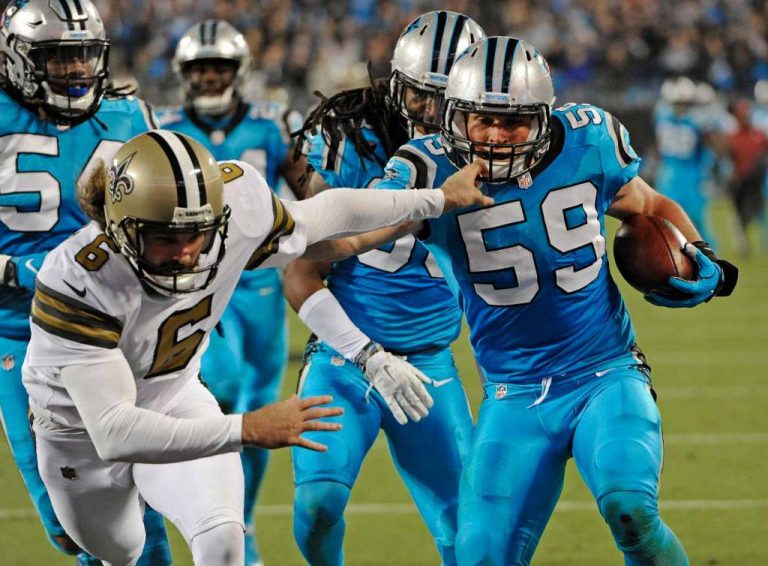
One of NBC's Thursday Night Football games between the New Orleans Saints and Carolina Panthers. Photo: Mike McCarn, AP
NBC’s first-ever telecast of Thursday Night Football averaged 13.3 million TV-only viewers – ranking as the network’s most-watched Thursday night show in November since 2006, excluding Thanksgiving nights (13.4 million viewers for ER on 11/30/06).
The Carolina Panthers’ 23-20 victory over the New Orleans Saints averaged a Total Audience Delivery (TAD) of 13.6 million viewers across all platforms – NBC, NFL Network, Twitter, NBC Sports Digital, and NFL Digital, according to Fast National data released by The Nielsen Company. TV viewership on NBC and NFL Network peaked at 15.8 million from 9:45-10 p.m. ET. The game registered a national household TV rating of 8.1 percent.
The Average Minute Audience (AMA) for the live stream via Twitter, NBC Sports Digital, and NFL Digital was 305,000 viewers. In total, Twitter reached 3.4 million combined worldwide viewers for pregame coverage and Saints-Panthers for a minimum of three seconds with that video being 100 percent in view.
This story first appeared in the blog, The Sport Intern. The editor is Karl-Heinz Huba of Lorsch, Germany. He can be reached at [email protected]. The article is reprinted here with permission of Huba.
Houston defeated Louisville 36-30 on Thursday. Photo: ERIC CHRISTIAN SMITH/AP
The unranked Houston Cougars took a commanding lead in the first half and cruised to a stunning 36-10 upset win against the third-ranked Louisville Cardinals to earn the College Football Game of the Week honor from the United States Sports Academy.
Louisville, which had only one loss for the season prior to Thursday’s matchup, fumbled the opening kickoff and Houston (9-2) scored on the ensuing play with a Greg Ward Jr. touchdown pass to Duke Catalon. The Cougars followed the touchdown with a 33-yard field goal from Ty Cummings and took a 10-0 lead by the end of the first quarter. The Cougars broke the game open in the second quarter with another Ward-to-Catalon touchdown pass, a Catalon rushing touchdown and a 50-yard touchdown pass from Linnell Bonner to Chance Allen. Houston led 31-0 at the half.
Louisville entered the game ranked third in the Associated Press poll and fifth in the College Football Playoff rankings. Louisville quarterback Lamar Jackson – the presumptive Heisman Trophy frontrunner – was sacked 11 times by the Houston defense, which also held Jackson to a season-low 33 rushing yards.
In the fourth quarter, Houston added a 46-yard field goal from Cummings. The Cougars were also awarded a team safety when Jackson was flagged for intentional grounding in the Cardinal end zone with three minutes left to play in the game. The Cardinals are 9-2 after the loss and have fallen number 11 in the AP poll.
A blue ribbon panel of 17 members consisting of former college football coaches and athletic directors and including Academy faculty selects the weekly winner of the Academy’s College Football Game of the Week Award by ballot. The committee is chaired by former U.S. Naval Academy athletic director Jack Lengyel. At the conclusion of the college football season, the panel selects the Academy’s College Football Game of the Year.
The College Football Game of the Year Award is part of the Academy’s Awards of Sport series, a function of the American Sport Art Museum and Archives (ASAMA), which was established as “a tribute to the artist and the athlete.”
Each year at the conclusion of the college football season painter Daniel Moore, the ASAMA 2005 Sport Artist of the Year, is commissioned by the Academy to render a painting depicting a memorable and pivotal moment to commemorate the selected College Football Game of the Year. In addition, the Academy contributes $5,000 to the winning university’s scholarship fund.
Fans are encouraged to follow the Academy’s Game of the Year process and compare their selected games of the week to the committee’s selection.
Based in Daphne, Ala., the United States Sports Academy is an independent, non-profit, accredited, special mission sports university created to serve the nation and world with programs in instruction, research, and service. The role of the Academy is to prepare men and women for careers in the profession of sports. For more information about the Academy, call (251) 626-3303 or visit www.ussa.edu .
Founded in 1984, ASAMA is dedicated to the preservation of sports art, history, and literature. The ASAMA collection is composed of nearly 2,000 works of sport art across a variety of media, including paintings, sculptures, assemblages, prints and photographs. The museum is open free to the public from 9 a.m. to 5 p.m. weekdays. For more information, go to www.asama.org.
By Eric Mann
Eric Mann is the communications assistant at the United States Sports Academy. He can be reached at [email protected].
Surfer Bethany Hamilton, who lost an arm after a shark attack, surfs during the Fiji Womens Pro earlier this year. Photo: dailytelegraph.com
Will. Determination. Force of character. Chutzpah. Courage. Daring. And we could probably think of several other similar synonyms, yes? But don’t ya just love “moxie?” I mean, as a word. It’s one of those words that are somehow just…easy to hear.
As a concept, don’t we also just love “moxie?” I mean, c’mon. We do. Well, at the very least, we admire moxie – when people show moxie, or have moxie. Yes – let’s be real. As humans, we love to see moxie on display. Why? Well, I submit that, at least in part we love to see moxie –because it gives us hope. Life is hard, right. But moxie makes it better. We admire moxie too, because we are hopeful that we have all the moxie we need, somewhere down the road, whenever we need it.
Youth softball player. Photo: nays.org
And so right there is another great reason why we so enjoy recreation and sports – because recreation and sports give us a chance. The chance – to show courage, a call – to rise to a challenge, a willing desire – to demonstrate moxie. Playing games is one thing – but the thrill of showing moxie? – that’s on a “whole notha level.” And when we get right down to it – moxie is fuel for the soul.
By Dr. Rodney J. Blackman
Dr. Blackman is the Chair of Recreation Management at the United States Sports Academy, and can be reached at[email protected].
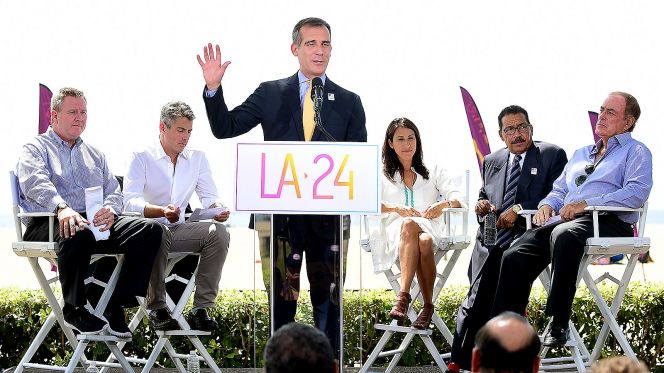
Los Angeles 2024 delegates Casey Wasserman, Allyson Felix, Janet Evans and Angela Ruggiero at the ANOC General Assembly in Doha. Photo: Team USA
After simmering along gently over the last 12 months, the race for the 2024 Summer Olympic and Paralympic Games is beginning to boil up.
Sport has simply been too preoccupied with anti-doping and Rio 2016-induced hysteria to divert too much attention onto a contest for which runners and riders were still being decided.
Most of our focus until now has been on problems with the process: withdrawals from Boston and Hamburg followed by the “self-suspension” of Rome last month after a failure to gain Mayoral support. Clearly, the attempted Agenda 2020-induced reinvigoration rolled-out by the International Olympic Committee (IOC) in 2014 has had only a limited benefit so far.
But the three cities who are left showed during last week’s Association of National Olympic Committees (ANOC) General Assembly in Doha that they each have real potential.
All three gave their first 20 minute international presentation in the Qatari capital in an opening test seen as the Olympic bidding equivalent of the Iowa Caucus.
I somewhat hastily tweeted straight afterwards that I felt Los Angeles had done the best job of conveying a strong and effective message. This did not go down too well with one prominent Paris consultant, but it was clear many other observers felt the same.
Sun and the power of Hollywood shone throughout, but so did more powerful language about creativity, finance and – crucially – a lack of risk. “If you think about it,” smirked bid leader Casey Wasserman, “each Olympic and Paralympic Games is a five billion dollar start-up. And nobody does start-ups like the people in California.”
Los Angeles 2024 officials hope to have a good relationship with U.S. President Elect Donald Trump. Photo: FREDERIC J. BROWN, Fox Sports
One perceived problem for Los Angeles surrounds the possible impact of soon-to-be-inaugurated United States President Donald Trump. In what many considered a masterstroke, this was addressed by six-time Olympic champion sprinter Allyson Felix who is also, without wanting to state the obvious, a black woman.
“We just finished our Presidential election, and some of you may question America’s commitment to its founding principles,” she said. “I have one message for you: Please don’t doubt us. America’s diversity is our greatest strength.”
The stark nature of her words reminded me of a similarly aggressive but effective speech given by Kazakhstan Prime Minister Karim Massimov in which he highlighted “real snow” when Almaty came so close to beating Beijing in the 2022 race last year. Confronting the elephant in the room head on.
Both were written by consultant turned Los Angeles 2024 marketing director Terrence Burns and, while it remains to be seen if such a direct approach will always be the most effective, it certainly made an impression here.
Two challenges surround the LA bid so far as I can see.
The first, which is more of a question mark than a specific problem at this stage, concerns their finances and technical plans. Unlike their two rivals, the Californian city neglected to publish their venue costs in their second candidature file submission last month. It was omitted to “protect LA24 proprietary information” although they claim the IOC have all the details and that they will be published in full by February, if not before.
They are also the only one of the three not yet to have finalized all of their venues. Homes for archery, modern pentathlon and mountain biking are still yet to be confirmed, although organizers insist announcements will be made soon. They are also planning to have just one overall operational budget for the Games because of an apparent absence of wider infrastructural costs. Their effort will also be “privately financed” with no dependence on the public purse.
But with Rio 2016 still awaiting state funds in order to make payments owed to staff and contractors, despite having made a similar claim about “no public money” being used, we would not be doing our job properly if we were not slightly skeptical.
A second issue concerns the perceived “arrogance” which has hindered previous American Olympic bids. Several IOC members have raised this as a challenge despite LA claims that they are different from past attempts. One even said that their bid presentation was so “smooth” and focused on “how California can help the IOC” that it came across as conceited.
There are two key figures within the bid team who can remedy this: IOC Athletes’ Commission chair and chief strategy officer, Angela Ruggiero, and chief executive Gene Sykes. Both come across as approachable, willing to listen and humble despite their high-level respective backgrounds as an Olympic ice hockey gold medal winner and a Goldman Sachs financial bigwig. Sykes’ style bears similarities with another Goldman Sachs man in London 2012 Organizing Committee chief executive Paul Deighton. He is also a Republican in a Democrat-dominated team, which could be key domestically.
Paris mayor Anne Hidalgo. Photo: AFP Photo/Francois Guillot
Paris also have some highly effective figures within their bid team. Leading the way is co-chair Tony Estanguet. While Ruggiero appears to have grown into the role, the three-time canoe slalom Olympic champion turned Athletes’ Commission vice-chair is a natural.
“The best speaker across any presentation,” one IOC member said about him afterwards. His performance at yesterday’s World Anti-Doping Agency Foundation Board meeting showed he could have a sporting future far beyond Paris 2024.
I got a dose of the Gallic charm when asking Paris chief executive Etienne Thobois what he had learned from his previous role overseeing finances as a consultant for the Tokyo 2020 bid – which produced a budget city authorities now claim was grossly undercooked.
After Thobois had answered, Estanguet took over and said: “We have a collective responsibility on this point – this is key. We really have to take this point seriously if we want to be able to host any other events in the future. Really we will not cheat with the figures this time.”
Technically, their bid does seem strong and, as double Olympic judo champion Teddy Riner pointed-out during the presentation, 22 sports will all lie within a 10 kilometers radius of the Olympic and Paralympic Village. Their message pledging to ensure full-stadia was also a good one post-Rio.
While a California Legislative Analyst Office (LAO) report last week warned Los Angeles 2024 would only have a “neutral” economic impact for the region, Paris have prioritized legacy benefits. I spent a day with bid team members on a promotional trip to Marseille in September, one of many they have done across the country, and it seemed they are genuinely trying to involve all citizens, and particularly the young.
This came across in the speech of Estanguet’s fellow bid leader Bernard Lapasset in Doha. “The legacy of Paris 2024 will see sport as a driver of positive change,” he declared. “Education, health and social inclusion.”
Parisian Mayor Anne Hidalgo also outlined how her city had supposedly “taken the lead” on worldwide responses to issues such as climate change.
The only thing I would say here is that I have spent a fair bit of time with IOC members over the last three years and I have never once heard a single one talk about global warming – in fact it may be hard to find a group of 98 people with a worse carbon footprint. “Sustainability” may be one of the Olympic Movement’s favorite buzzwords, but I wonder if the LA messages about money and technology may be more powerful.
That said, it remains early stages and, with Paris’ consultants including Nick Varley, the architect of winning speeches for London 2012, Rio 2016 and Tokyo 2020, I suspect they will build-up their presentational momentum as we build towards the September 13 judgement day in Lima.
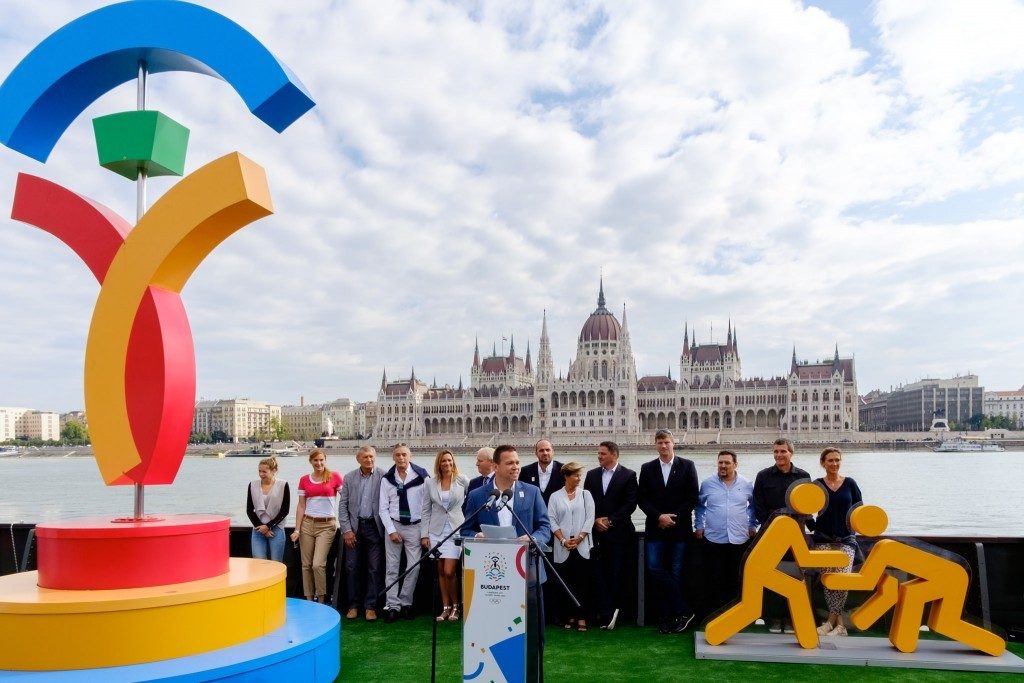
Budapest 2024 has opened a visitor center on the River Danube. Photo: Budapest 2024
Budapest, of the three, have perhaps the most powerful message in the slogan: “right city at the right time”. In a strong performance in Doha, bid leader Balázs Fürjes did a good job of explaining how they offer an exciting alternative, but also – and this is key post Rio 2016 – how they can provide an option that can be trusted to succeed.
“We have the fundamentals in place,” he said “Because a mid-sized global city such as Budapest can offer a truly compact and intimate Games experience. A mid-sized city can deliver a Games at reasonable scale and reasonable cost. And this is a Games that will transform the city and leave a lasting legacy.
“A Games in Budapest sends the message that the Olympic Games are not simply for the mega-city but for mid-size cities.”
Hungary is the most successful medal winning nation never to have hosted the Olympic Games, remember, and they must now convince voters that the benefits of going somewhere new outweigh the risks.
My concern is that, in comparison with the other two, their lobbying effort appears weaker. Paris and Los Angeles leaders were everywhere in the Sheraton Hotel last week as they frantically hunted for the 50 or so IOC members present. Budapest were far less visible, and it was notable that when asking people about the race they, almost without exception, mentioned either the French or US bids first.
Hungarian IOC member Pal Schmitt was present, and it is vital they get well-connected old hands like him involved as much as possible. It was unfortunate new Athletes’ Commission member Daniel Gyurta was ill and unable to travel last week and, as a newbie, it will be hard for him to match Ruggiero or Estanguet when he does appear. Surely the likes of International Weightlifting Federation President Tamas Ajan should be helping out? And why not International Judo Federation counterpart, Marius Vizer, described usually as a Romanian-born Hungarian?
It is too early to count them out, and certainly they can emerge as a viable third option if rival efforts go sour – security fears for Paris and the “Trump” factor for LA appear the most likely reason for this. At present, however, it appears Budapest have some catching up to do.
Bizarrely, the Agenda 2020 reforms introduced by the IOC ostensibly to reduce costs and stop richer bids gaining an advantage have backfired. Because they have less formal opportunities to present and showcase themselves than before, it has become harder for Budapest to stand-out and make up the ground as the importance of lobbying becomes ever more vital.
All three bids, it is worth pointing out, constantly moan to us about the IOC’s increasingly dictatorial restrictions on promoting themselves. Latest measures included journalists being banned from taking photos as they presented… (with the IOC doing their usual trick of getting ANOC to tell the journalists this rather than do it themselves).
Perhaps IOC President Thomas Bach should think about this the next time he claims, as he did in Doha, that Agenda 2020 has saved the Games and was directly responsible for all three bids being launched.
It is nigh-on impossible to pick a favorite at this stage.
Paris insiders are claiming that, to quote rapper Eminem, this is their “one shot, one opportunity.” They claim that if they are not successful this time, the French capital will cease trying whereas, if they win, another US city would be likely to bid for 2028. On the other hand, there are important commercial and financial incentives for choosing California to the extent that the IOC will be both a winner and a loser whoever wins.
It will also be interesting to see whether Bach or ANOC President Sheikh Ahmad Al-Fahad Al-Sabah clearly align themselves to one bid and, if they do, how many members will listen.
It should be a fascinating 10 months building up to the vote in Lima.
Athletes can learn valuable lessons about life by playing sports. Photo: Randall Hill, Reuters
Early Sunday morning workouts are when some of the best conversations happen at the gym. It happened to be one of those late summer mornings at my strength and conditioning studio when I entered a philosophical mood, so I started talking about the ethics of cutting athletes from high school sports teams. On one hand it teaches young adults that are often labeled as the “trophy” generation the value of working hard to earn something of meaning. It teaches young athletes to take responsibility for their outcomes. If these athletes try out and do not get on the team it is not anything against them, rather a reminder that other people are working hard to make the team as well. It sends a message that if they want to be part of something meaningful, they have to earn their spot. On the other hand, it cuts those same children from the lessons of life sports teaches us.
A couple of months prior to this philosophical sports talk I was teaching a sports management class at a local college when I asked the students to raise their hands if they ever played a sport. Being a sports management class, almost everyone’s hand instantly shot up with expressions of ‘this is stupid’ on their face. I then asked my students, who has ever learned a lesson from sports that they could never learn from school? I watched their facial expressions change as they realized where this was going. Only a couple of hands went down. The point of the question as I explained to the class was, there are real life lessons regarding relationships, respect, grit, delayed gratification, and countless other topics that simply cannot be taught in a classroom or a book. I proceeded to ask the class the same question I was asking my client on this Sunday afternoon. Is cutting children from a high school sports team worth excluding them from the lessons sports provide for the sake of hopefully creating a winning team?
This question is a trick question in the sense, are the athletes not learning a lesson about sports and life by being cut from the team? Lessons regarding effort and reward, finding the fit for you, discovering your strengths and accepting your weaknesses so you can learn from them and grow. It teaches athletes that if they desire something meaningful they have to meet the standard. If the standard is lowered, the goal loses its meaning. In ancient Rome a marker referred to as a Standard was placed at the furthest point of advance during battle so the warriors had a physical representation of where they were and how much ground they still had to conquer to reach their goal. If the warriors were pushed back, so was the Standard. In ancient war, this was a powerful reminder to keep pushing forward.
It happened to be that my client on this Sunday morning was an addiction and behavior change expert and we covered a lot that morning about sports and addiction behavior change. Most significantly the correlation between athletes not making a team and addiction behavior change. Not everyone in daily life makes it on their first attempt. Most of us have heard the stories of President Lincoln and his failed businesses or Michael Jordan being cut from his high school basketball team.
Some people need a wake up call to realize how badly they want something. Addiction can ruin people and sometimes it takes a blunt hit to their personal life to realize what is happening. Like the lessons we learn from sports, this stimulus to change cannot be taught in a classroom or from a book. The individual suffering from the undesired behavior has to experience the setback first hand. They need to be part of the story they are learning.
After realizing this connection, the two of us postulated how individuals in need of behavior intervention could benefit from the mechanics of lessons learned from sport. We concluded that only through sport could these individuals learn the lessons of sport. And only then could they transfer those lessons to behavior change in such areas as drug and alcohol addiction. Sports act as a reference point for learning how to adapt and change.
Sports are an astonishing tool for behavior change. Where else do you take an action and see as well as feel a physical manifestation occur to your body? With time invested in themselves and their sport, athletes feel and see a change to their physiology. With that said, success fuels success. Meaning, as athletes see this change occurring, they want to work towards additional positive changes to their body and performance. Why can’t this occur with substance addiction? Why can’t an individual use sports as an intervention to substance abuse?
It is amazing to think of sports we play as children as a lifesaving mechanism, but that is what sports are, a mechanism created to emulate real life situations. Not all of the interventions people experience are as dramatic as substance abuse, but that does not mean sports do not have a place in life changing intervention.
Who has ever sacrificed something important in their life for a sport only to look back at the event during a tough time and say, “this has nothing on that winter I was training for a marathon in the spring and we had over 100 inches of snow on the ground in Boston. Sometimes it felt like running, other times like mountaineering, but regardless of what it felt like, it was way more discouraging than this.” Sports can teach people a lot about life and sports have the power to change life. By understanding this concept it switches the lens through which we view sport from a simple pastime into an instrument of success. An instrument capable of teaching us lessons about life that no teacher can express.
By Chris Johnson
Christopher P. Johnson is an educator and co-founder/ head strength and conditioning coach at Boston Strength and Conditioning, llc in Newton, Ma. He received his Masters of Management degree as well as his Bachelors of Science Degree in Sports Science from Lasell College, and is currently pursuing a terminal degree through the United States Sports Academy.
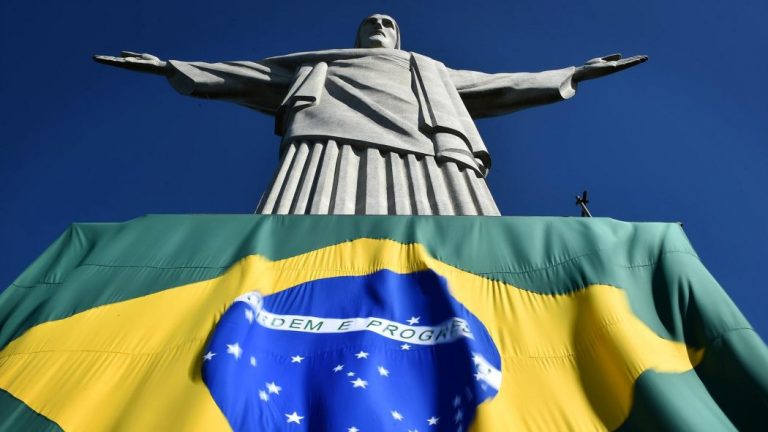
Olympic and Paralympic Games host nation Brazil, Azerbaijan and Indonesia were declared non-compliant by the World Anti-Doping Agency (WADA) during the organisation’s Foundation Board meeting in Glasgow.
The three National Anti-Doping Organisations (NADOs) were named as being at risk by the Compliance Review Committee (CRC) following a meeting in Montreal last month, along with Guatemala and Greece.
Guatemala and Greece escaped punishment, however, after the CRC informed the Foundation Board that issues with their anti-doping measures had been resolved.
The CRC officially put forward declarations of non-compliance for Azerbaijan, Brazil and Indonesia and these were all accepted by the Foundation Board as problems in the respective countries have not been rectified.
Azerbaijan and Brazil were “deemed not to have 2015 Code compliant legal framework in place”, WADA said.
The decision on Indonesia’s came “as a result of using a laboratory not accredited nor otherwise approved by WADA and not having provided evidence of this situation having been remedied”.
Indonesia will host the 2018 Asian Games in Jakarta and Palembang.
Eduardo de Rose, a member of the WADA Executive Committee and the President of the Pan American Sports Organization Medical Commission, told the members of the 38-strong Foundation Board that he did not expect Brazil to be non-compliant for long as issues in the nation were being fixed.
Brazil being non-compliant still represents another embarrassing development for the country after a WADA Independent Observers report, published last month, highlighted a number of “serious failings” in the anti-doping program at Rio 2016, “some of which” were within the control of the Organizing Committee.
This included a loss of service due to budget cutbacks as well as “tensions” between organizers and the Brazilian Anti-Doping Agency.
It was also revealed that more than 4,000 athletes were not drugs tested in 2016 before competing at the Games.
This came after Brazil was criticized by WADA during the Olympics in August for halting its drug testing program in the build-up to the Games.
The country’s Sports Ministry confirmed no anti-doping tests were carried out between July 1 and July 24, a move described by WADA as “unacceptable.”
Brazil claimed the decision was made after WADA suspended its testing laboratory in Rio de Janeiro in June.
The suspension was subsequently lifted, which led to WADA questioning why the second largest team at the Olympics was not being properly monitored at such a “crucial time.”
Brazil were briefly placed on a watch-list by WADA’s Foundation Board last November, but the establishment of a unique Brazilian anti-doping tribunal and the implementation of the Code within their legal system saw them avoid being declared non-compliant in March.
WADA threatened Azerbaijan with non-compliance in July.
Concerns were addressed in a meeting that same month and some assurances were given, WADA said afterwards, but a “whole range of recommendations from previous reports” had still not been acted upon.
Azeri officials claimed they did not have the funds to carry out testing because their budget had been taken up by hosting the inaugural European Games in Baku last year.
The World Rugby Hall of Fame is open in Rugby, England. Photo: worldrugby.org
The World Rugby Hall of Fame has been officially launched in Rugby, England, following a star-studded grand opening in the town and induction of 12 more greats of the game on Thursday.
The Hall of Fame, a fully interactive and immersive experience, celebrates the history of the sport from innovative and rule-breaking beginnings with William Webb Ellis and Rugby School, right through to the present day with 132 greats, pioneers and administrators inducted to date. World Rugby Chairman Bill Beaumont and the Mayor of Rugby Sally Bragg officially cut the ribbon on a day when stars from the game congregated in the town that gave birth to the sport and its name.
“Today we celebrate the greats who have inspired generations of players and fans with their feats on rugby fields around the world. We also celebrate formalizing the link between the sport’s beginnings in Rugby with World Rugby as the game’s governing body. Through this partnership with our friends and colleagues in Rugby and the support of the people of this great town, we hope to welcome the world to rugby the sport and Rugby the town and inspire the next generation of players and supporters,” Beaumont said.
A new website has also been launched, complementing the physical Hall of Fame, with visitors being able to access a complete timeline of the game and the moments that have shaped a sport.
This story first appeared in the blog, The Sport Intern. The editor is Karl-Heinz Huba of Lorsch, Germany. He can be reached at [email protected]. The article is reprinted here with permission of Huba.
Chicago Cubs owner Tom Ricketts, right, with Cubs president of baseball operations Theo Epstein. Photo: Chicago Tribune.
Chicago Cubs owner Tom Ricketts got up from his desk chair, reached up to the top shelf of his dusty bookcase and pulled down a replica of the famous 1948 Norman Rockwell painting The Dugout.
Qualcomm Stadium during Chargers' playoff game against New England, 1/14/07. By Bspangenberg - Own work, CC BY 3.0, https://commons.wikimedia.org/w/index.php?curid=3351662
While the Spanos family attempts to figure out the next move in finding a home for the family owned San Diego Chargers following the Election Day referendum loss which would have funded a new football stadium, there are some rumbles that perhaps the time is soon to ask San Diego residents whether they want to help fund a new arena.