US divers Amy Cozad and Jessica Parratto dive into the green pool during the Rio 2016 Olympic Games. Photo: Michael Dalder / Reuters
International Swimming Federation (FINA) President Julio Maglione has reportedly claimed the pool for Tokyo 2020 will not experience the same problems experienced at the Rio 2016 Olympic Games.
Construction of the swimming pool was hit by several setbacks in the build-up to Rio 2016, although it was not one of the worst effected venues by delays.
Organizers also suffered embarrassment when the diving pool at the Maria Lenk Aquatics Center turned green during the Games.
Brazilian officials claimed a contractor mistakenly dumped hydrogen peroxide into the pool, which reacted with the chlorine and changed the color.
Maglione has played down any concern that Tokyo 2020 could experience similar problems to Rio 2016, with the FINA chief expressing his confidence in the Japanese organizers.
“I visited the place where they are beginning to build the new swimming pool and it will have all the requirements for an excellent championship because the last condition in Rio was different,” Maglione said, according to Kyodo News.
“We are sure that it will be fine here.”
Tokyo organizers are still debating whether the Olympic Aquatics Stadium should house 15,000 or 20,000 spectators, with concerns remaining over ballooning costs.
A Tokyo Metropolitan Government Task Force commissioned by the city’s new governor, Yuriko Koike, proposed in September that venues for rowing and canoe sprint, volleyball and swimming be moved in order to avoid an overall budget rise to $30 billion.
It was recommended that swimming take place at the existing Tatsumi International Swimming Center where water polo is currently scheduled to be held.
FINA executive director Cornel Marculescu called for Tokyo to stick with its plans during a visit to the city in October, where he met with Japan Swimming Federation President Tsuyoshi Aoki.
The proposed new Olympic Aquatics Stadium will be built in Koto Ward in the Tokyo Bay zone, in order to house swimming, diving and synchronized swimming competitions.
This facility is expected to cost $653 million.
Other changes currently under consideration include a move of rowing and canoe sprint venues, 400 kilometers away to the Naganuma rowing course in Tome.
This is also being opposed by sporting bodies, who believe the originally proposed Sea Forest venue is the only one to meet all of their requirements.
Richard McLaren, who was appointed by the World Anti-Doping Agency (WADA) to head an independent investigative team, prepares to leave after presenting his report in Toronto, Ontario, Canada July 18, 2016. Photo: REUTERS/Peter Power
Richard McLaren’s final report into doping in Russia, commissioned by the World Anti-Doping Agency (WADA), will be released on December 9 at the St Pancras Renaissance Hotel in London, it was officially confirmed today.
The report will be unveiled by Canadian lawyer McLaren in a press conference at 11.15 a.m. in the British capital.
Described as an “extended mandate,” it will then be published in full on the WADA website.
“On May 18, Professor McLaren was appointed by the WADA as the Independent Person to head an investigative team charged with determining the facts with respect to the allegations of manipulation of doping control samples and other allegations made by Dr. Grigory Rodchenkov, the former Director of the WADA-accredited Moscow Laboratory,” a statement today said.
“The investigation was launched to establish what actions must be taken in the best interest of clean sport and clean athletes.”
McLaren produced his initial findings at a press conference in Toronto in July shortly before the beginning of the Olympic Games in Rio de Janeiro.
It investigated claims, first made by Rodchenkov in the New York Times, that Russia had operated a state-sponsored scheme during the 2014 Winter Olympic Games in Sochi.
He claimed an operation was put in place where tainted stories were illegally switched for clean ones in a clandestine night-time operation.
It is alleged that up to 15 Russian medal winners are implicated – with McLaren expected to focus on this in his investigation.
He is also thought to be exploring allegations of similar activities at other events held in Russia, including the 2013 World Athletics and 2015 World Swimming Championships in Moscow and Kazan respectively.
WADA recommended Russia be handed a blanket ban from Rio 2016 as a result of the allegations, although the International Olympic Committee (IOC) rejected this and instead handed responsibility to individual International Federations.
The final report will be unveiled the day after the conclusion of an IOC Executive Board meeting in Lausanne.
McLaren’s findings are expected to form the basis of two separate IOC investigations conducted by French judge and IOC Ethics Commission vice-chair Guy Canivet and by Swiss IOC member Denis Oswald.
It could then lead to many other repercussions, including winter sporting events being removed from Russia.
A woman walks into the head office for the World Anti-Doping Agency (WADA) in Montreal, Quebec, Canada on November 9, 2015. Photo: REUTERS/Christinne Muschi/File Photo
The World Anti-Doping Agency (WADA) will take legal advice before making any move to reintroduce the controversial Osaka Rule.
“We will take legal advice before inserting it into the Code,” Sir Craig Reedie, WADA’s newly-re-elected President, told insidethegames.
“We are reluctant to put anything in the Code that runs the risk of being overturned.”
International Olympic Committee (IOC) member Tony Estanguet publicly raised the issue at Sunday’s WADA Foundation Board meeting in Glasgow, calling for athletes who had served suspensions longer than six months to be excluded from the next edition of the Olympics.
“The IOC would like to propose a new amendment to the Code regarding the eligibility of athletes to compete at the Olympic Games,” the Frenchman, a three-time Olympic champion in canoe slalom, said.
“If there are athletes who have served a suspension of more than six months, they should not participate in any capacity in the next edition of the Games.”
Any such move would be widely backed both by athletes and, presumably, Sir Craig himself, who was on the board of the British Olympic Association (BOA) in 1992 when it initiated a bylaw which banned any athlete convicted of a serious doping offence from representing Team GB at the Games.
But the juridical history of the matter strongly suggests that WADA is wise to move cautiously.
The so-called Osaka Rule – previously Rule 45 of the Olympic Charter – was originally drafted to allow the IOC to prevent athletes who had received a doping sanction of more than six months from representing their country at the Olympic Games.
It was introduced by the IOC in 2007 during the International Association of Athletics Federations (IAAF) World Championship in Osaka.
It was, however, successfully challenged by the United States Olympic Committee (USOC) in 2011 on behalf of Beijing 2008 400 meter champion LaShawn Merritt at the Court of Arbitration for Sport (CAS).
The USOC claimed the rule was unfair because it was effectively punishing an athlete twice for the same offence, and CAS agreed.
Following the USOC’s challenge, WADA successfully overturned the BOA’s bylaw.
Notwithstanding the legal complexities, raising the issue once again in a public forum while anti-doping issues are so much in the public eye appears a clever PR move by the IOC, which is still under fire for its role in permitting so many Russian athletes to compete at this year’s Rio Olympics, after WADA advocated a blanket ban.
This vexed issue will return to the top of the news agenda next month, with Richard McLaren’s WADA-commissioned final report into doping in Russia to be released in London on December 9.
University of Alabama head coach Nick Saban. Photo: Matthew Emmons | USA TODAY Sports Images
Happy Thanksgiving everyone. With just two weeks remaining before the College Football Playoff field is set, let’s take a look at all the teams with a fighting chance of securing a bid. The teams have been broken into three categories based on their chances of making the final four. The first group consists of those teams that are absolute locks if they win out. The second group consists of teams that need to win out but also need a little shakeup in the first group. The third group needs to win out and have absolute chaos occur in the top two groups. Enjoy what should be a great weekend of college football.
Win out, get in
#1 Alabama (11-0, 7-0) Remaining Games – vs. Auburn, SEC Championship Game vs. Florida: Alabama is in such good shape that they could lose one of their final two games and still secure a playoff bid. Auburn is out of the playoff hunt after a loss to Georgia two weeks ago, but rivalry games are always hard to predict. Florida could keep the SEC title game close, especially if their defense plays as well as they have in recent weeks. Don’t expect Alabama to lose either of these games. They should be a lock for the #1 seed in the playoff.
#2 Ohio State (10-1, 7-1) Remaining Games – vs. Michigan, possible Big Ten Championship Game: The Buckeyes have two paths to the playoff. The first path is to beat Michigan but not advance to the Big Ten title game if Penn State beats Michigan State. They would finish 11-1 with wins over Oklahoma, Wisconsin, Nebraska, and Michigan. The second path is to beat Michigan and advance to the Big Ten title game if Michigan State beats Penn State. They would then need to win the title game over either Wisconsin or Nebraska to get into the playoff. It may actually be better if Penn State wins so that the Buckeyes get an extra week off instead of having to win the Big Ten title game. Their playoff hopes are busted if they lose to Michigan this week.
#3 Michigan (10-1, 7-1) Remaining Games – at Ohio State, possible Big Ten Championship Game: A win at Ohio State won’t be easy, but Michigan knows it has a paved path to the playoffs with two more wins. Michigan has wins over Colorado, Penn State, and Wisconsin. Add in wins at Ohio State and either Wisconsin or Nebraska in the Big Ten title game, and this is a playoff team. The dream of a playoff spot is gone if they lose to Ohio State.
#4 Clemson (10-1, 7-1) Remaining Games – vs. South Carolina, ACC Championship Game: Clemson has secured a berth in the ACC title game and is a clear favorite over South Carolina this week. The Tigers recovered from their only loss of the season to Pittsburgh by dominating Wake Forest. As with the other teams in this group, they can’t drop one of their two remaining games. The ACC title game will feature either Virginia Tech or North Carolina. Last season, Clemson only beat North Carolina by eight points in the ACC title game.
#6 Wisconsin (9-2, 6-2) Remaining Games – vs. Minnesota, possible Big Ten Championship Game: Wisconsin has two losses, but they still look to be in good shape if they win their final two games. Minnesota has been flying under the radar with an 8-3 record, but Wisconsin gets to play them at home. A win here secures a spot in the Big Ten title game against either Michigan, Ohio State, or Penn State. The Badgers have wins over LSU, Iowa, and Nebraska. Add in a Big Ten title, and this team is a lock for the playoff.
The Penn State Nittany Lions need a little help from rival Ohio State to make the College Football Playoff. Photo: Centre Times Daily
Win out, need help
#5 Washington (10-1, 7-1) Remaining Games – at Washington State, possible Pac 12 Championship Game: Washington recovered nicely after their loss to USC by dominating Arizona State. Their rivalry game against Washington State took a hit after the Cougars were beaten by Colorado this past week. The strength of schedule is the piece of the puzzle that is hurting the Huskies. They need to beat Washington State handily and then beat either USC or Colorado in the Pac 12 title game. Even if they finish 12-1, they still need some help. The best scenarios for them are if only one team gets in from the Big Ten or if Clemson loses a game down the stretch.
#7 Penn State (9-2, 7-1) Remaining Games – vs. Michigan State, possible Big Ten Championship Game: Penn State will know exactly where it stands in the Big Ten and playoff pictures when they take the field against Michigan State this week. All eyes will be on the Ohio State/Michigan game, which will be played a couple hours earlier. If Michigan wins, they advance to the Big Ten title game ahead of Penn State. If Ohio State wins, Penn State can advance to the Big Ten title game with a win over Michigan State. It is critical that Ohio State wins to open the door for Penn State. Penn State must win the Big Ten title game to secure a playoff spot.
#8 Oklahoma (9-2, 8-0) Remaining Games – vs. Oklahoma State: Oklahoma owes Houston big time. Not only did Houston knock off Louisville last week to help Oklahoma move up in the rankings, but the win also helps Oklahoma’s loss to Houston not look quite as bad. The Sooners have steadily improved all season, and a win last week in West Virginia should give the committee plenty to think about. Their rivalry game against Oklahoma State will be crucial in their hunt for a playoff spot. A win would secure the Big 12 title and also give them an undefeated record in conference play. As with Washington, they still need help. One Big Ten team getting in, a Clemson loss, or a Washington loss create some avenues for Oklahoma to get into the playoff.
#9 Colorado (9-2, 7-1) Remaining Games – vs. Utah, possible Pac 12 Championship Game: Colorado has quietly risen in the polls every week, and they have put themselves in a position to win a Pac 12 title and have a strong case for a playoff spot. With a win against Utah, Colorado will advance to the Pac 12 title game against either Washington or Washington State. They really need Washington to be that team and then beat them easily in the title game. Colorado’s two losses were at Michigan and at USC. A Pac 12 title along with a win over Washington would put them in the discussion for a playoff spot. They would need a couple chips to fall their way in other conferences, but they have put together a nice resume.
Florida head coach Jim McElwain and the Gators need to beat both Florida State and Alabama to have a chance at a berth in the College Football Playoff. Photo: David Goldman / Associated Press
Win out, need chaos
#10 Oklahoma State (9-2, 7-1) Remaining Games – at Oklahoma: Oklahoma State’s chances of advancing to the playoff would look a lot different right now if the outcome of the Central Michigan game had been changed. A wrong call by an official in that game incorrectly gave Central Michigan one extra play at the end of the game. Central Michigan completed a desperation Hail Mary pass to win the game on that final play. Oklahoma State should have won that game, and it will be interesting to see how the committee views that outcome if the Cowboys beat Oklahoma next week. The Cowboys have wins over Pittsburgh and West Virginia, and a win over Oklahoma would secure a Big 12 championship. They will still probably be on the outside looking in unless the committee gives them some grace for that loss to Central Michigan or if total chaos occurs in other conferences.
#15 Florida (8-2, 6-2) Remaining Games – at Florida State, SEC Championship Game vs. Alabama: Florida won a nail-biter at LSU this past week. They enter their rivalry game with Florida State with slim playoff hopes. The Gators have already secured a spot in the SEC title game against Alabama. With wins over Florida State and Alabama, it would be hard to leave Florida out. They will be underdogs in both games, and their offense has looked shaky all season. Their best hope is that their strong defense takes over and plays lights out.
#16 Nebraska (9-2, 6-2) Remaining Games – at Iowa, possible Big Ten Championship Game: Nebraska has no real chance at a playoff spot, but they certainly could play spoiler in the Big Ten. If Nebraska wins at Iowa this week, and if Wisconsin loses to Minnesota, then Nebraska wins the Big Ten West and advances to the Big Ten title game. A win against either Michigan, Ohio State, or Penn State could knock out the Big Ten completely from the playoff. It would be bizarre, but the Cornhuskers could claim the Big Ten title and cause mass chaos across the college football landscape.
#21 Western Michigan (11-0, 7-0) Remaining Games – vs. Toledo, possible MAC Championship Game: Western Michigan has almost no chance at a playoff spot, but they have had such a spectacular season, they could not be left off this list. The Broncos have two solid wins against average Big Ten competition in Illinois and Northwestern. They still have not secured a spot in the MAC title game, however. The winner of their game against Toledo will be crowned the MAC West champion. The best bet for Western Michigan is to win out and hope they become the highest ranked team in the Group of 5. This would secure them a spot in the Cotton Bowl against a high-ranked opponent.
By Ben Billman
Ben Billman is currently a doctoral teaching assistant at the United States Sports Academy. He lives in Mobile, Ala. with his wife Jennifer and son Derrick. He is originally from Indiana, and therefore has a deep love for the game of basketball. Reach him at [email protected].
Notre Dame head football coach Brian Kelly. Photo: Matt Cashore / USA Today Sports
The poor results on the field — the seven-loss debacle of a season — are nothing compared with the embarrassment and shame Brian Kelly just brought on Notre Dame.
Kelly refused to accept any responsibility Tuesday for NCAA violations that resulted in the Irish being stripped of 21 victories from the 2012 and 2013 seasons. The 12-1 record in 2012 that included a trip to the BCS title game, easily the high point of Kelly’s contentious tenure, is now vanished.
And right along with it Notre Dame’s moral high ground.
Notre Dame has always prided itself on being different, a cut above the college athletics world that, let’s be frank, sometimes looks more like a cesspool. It only recruited players of the highest quality, their character as sterling as their talent. Its coaches were the role models for doing things the right way, refusing to compromise their ethics for a couple of extra wins.
Turns out, Notre Dame’s principles are every bit as malleable as the Miamis, the Auburns and all those other schools it’s looked down upon over the years.
It’s true that Kelly did not have any direct involvement in the violations. The NCAA Division I Committee on Infractions found that a student-trainer had violated NCAA rules by committing academic misconduct for two football players and providing six others with impermissible extra academic benefits.
“It was student-on-student cheating,” Kelly said. “This matter has nothing to do with me and my status here.”
Wrong. As head coach, it is Kelly’s job to know everything that’s going on with his team, the good and the bad.
Maybe Kelly wouldn’t have first-hand knowledge. But when a team is this high profile, on a campus as insulated as Notre Dame’s, it’s implausible to think people didn’t know about the shadiness. If he or his assistants didn’t hear the whispers and the rumors, it’s because they didn’t want to.
If you want to take credit when the going is good, then you’d better be prepared to accept the blame when things go wrong, too.
And that, even more than his team’s woeful record, will be Kelly’s undoing. He’s had no problem throwing others under the bus when things have gone wrong – you could make a YouTube video of his sideline tantrums alone – and had the audacity to preach about the need for accountability when he disciplined six players who were arrested before the season.
“You want them to enjoy their time here, but they’ve got to make good decisions,” Kelly said in a radio interview after the August arrests. “And then if they don’t, hold them accountable for it, and we certainly have done that.”
Yet Kelly has shown time and again that his standards don’t apply to him.
When a video tower collapsed in October 2010, killing a Notre Dame student who was taping practice, Kelly defended his decision to practice outdoors that day by saying conditions “were not unlike many days that I had practiced.” I lived in South Bend for 3½ years and I can say with total certitude that winds gusting up to 53 mph are not typical.
When Lizzy Seeberg committed suicide in September 2010 after accusing linebacker Prince Shembo of sexual assault, Kelly was one of several university administrators who tried to sweep it under the rug.
Compared to those two incidents, the NCAA violations are minor. But it fits the pattern: Nothing is ever Brian Kelly’s fault.
The role of a college coach is twofold: Win games and try to set a good example for the young men he’s molding.
This article was republished with permission from the original author and 2015 Ronald Reagan Media Award recipient, Nancy Armour, and the original publisher, USA Today. Follow columnist Nancy Armour on Twitter @nrarmour.
Hall of Fame Coach Barry Switzer, GE CEO Jeff Immelt, Big 12 Commissioner Bob Bowlsby and SEC Commissioner Greg Sankey at the Congressional College Football Caucus’ kickoff event in September. Photo: williams.house.gov
Jeffrey Immelt is the CEO and Chairman of General Electric and is getting the National Football Foundation’s 2016 legacy award which should come as no surprise. Immelt played football at Dartmouth and went onto a career with General Electric which owned NBC at one point. NBC poured money into college football.
But there is something else in Immelt’s resume. In the news release announcing the award in a New York ceremony in December was this little nugget. Immelt, who has served on the National Football Foundation’s Board of Directors since 2012, was also important in the National Football Foundation’s creation of the first-ever Congressional College Football Caucus which took place in September in Washington, D.C.
That’s right college football not only has a lobbying presence on Capitol Hill but has a spot inside the building where the people’s business takes place. Texas Republican Roger Williams is the co-chair of the bipartisan committee which job seems to be to protect the best interests of college football’s revenue stream. Williams said all the committee wants to do is promote the game.
Of course, there is that pesky concussion and brain injury issue and whether football is safe, but Williams has left that to secondary status, “The main issue is look at all the futures and all the scholarships and all the education value it has.”
Alabama Democrat Terri Sewell is the co-chair. Just what issues that the committee will discuss is unknown except that college football is the greatest show on earth and no changes should be made and yes, the game is safe and yes, the players, who are the stars of the show should shut up play and be grateful that they got a scholarship and not worry about the possible long term effects of football injuries.
Still there is question that should be asked. Why is Congress protecting the best interests of college football?
Betty Cuthbert wins gold in the 1956 Melbourne Olympic Games. Photo: http://australiaforeveryone.com.au/
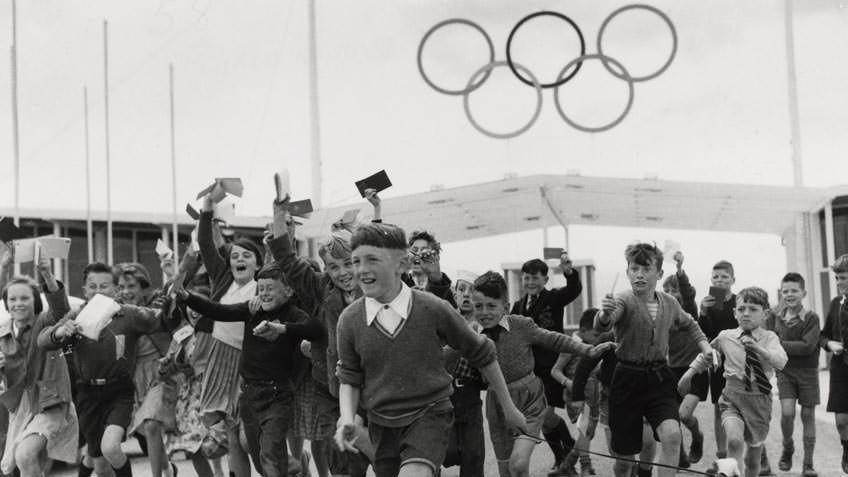
It all sounds very familiar. Warnings about the lack of progress from the International Olympic Committee (IOC), disputes over venues, delays in construction, strikes by workers, health concerns and even a team of refugees. But this is not a tale from Rio 2016 but 60 years ago.
Melbourne was preparing to become the first city from the southern hemisphere to stage the Games. This week in 1956, athletes from some 72 nations were gathering in the city.
In fact, Melbourne had won the Games by one vote from a South American city, Buenos Aires. These Olympics had been over a decade in the making. The Victorian Olympic Council had decided to table a bid in 1946, barely a year after the end of the war. The bid book was lavish, bound in suede. There was even an extra special version with a lambs wool cover.
The Prime Minister Ben Chifley told IOC members that his Government “cordially supports Melbourne’s plans for the holding of the Olympic Games in 1956” for what he described as “this historic event in the south-west Pacific.”
The decision was made in Rome in 1949. Melbourne sent a delegation of four, led by Lord Mayor James Disney. Curiously, Australian IOC member Hugh Weir was not present at such an important meeting, unable to attend because of business commitments.
The victory celebrations that night were marred by the activities of a smartly dressed confidence trickster who relieved many IOC members of the contents of their wallets. It was not an auspicious start.
Autograph hunters at the athletes’ village, Heidelberg, 1956. Photo: Herald & Weekly Times
When EJ Billy Holt, a chief organizer of the 1948 London Games, arrived to take up a planning role with the Melbourne Games, he found an organization locked in a bitter dispute about the site of the main stadium. No fewer than seven options were proposed including the Royal Showgrounds, Melbourne University and the Melbourne Cricket Ground (MCG).
Organizing chief Wilfrid Kent Hughes was drawn into the arguments. He was a supporter of using the MCG and talked bitterly of obstruction from “the arch priests of cricket.” In time it would need mediation from the likes of Prime Minister Sir Robert Menzies to find a solution.
Further squabbles about the financing of the Games, and the selection of other venues, presented a very negative picture.
Australian Athletics official Arthur Hodson warned: “There is no doubt what the International Olympic Committee will do about the 1956 Games if Melbourne cannot give a suitable guarantee.”
In 1952, the outspoken and dogmatic American Avery Brundage took over as IOC President.
He told Weir: “If there is the slightest doubt in your mind that the 1956 Games will be staged properly so they will be a credit to Australia and the Olympic Movement, give them up now and let us select another venue before it is too late.”
Melbourne seemed to be lurching from one crisis to another and in 1953 it became clear that their health legislation presented a very real problem. Quarantine laws would prevent the importation of horses for the equestrian competitions.
“Certain proposals have been submitted to the health authorities, with a view to special quarantine arrangements, under which it will be possible to bring horses into Australia, for the equestrian events,” organizers claimed. “These proposals are at present being examined, and we are hopeful that suitable arrangements will be evolved.”
It proved a vain hope. IOC Chancellor Otto Mayer called it “another black mark against Australia” and others echoed his irritation.
But the Australians found an ally in the British peer Lord Burghley, who suggested “begging our Australian friends to forgo the project of organizing the equestrian events.”
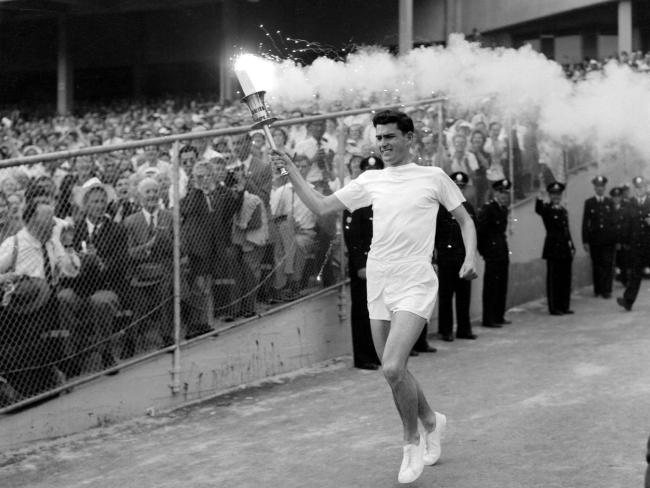
When Ron Clarke was 19 years old, he was chosen to light the Olympic Flame in the stadium during the opening ceremony of the 1956 Summer Olympics in Melbourne. Photo: theaustralian.com.au
Five cities, including Rio de Janeiro, entered the race to welcome the horses but in the end the IOC chose Swedish capital Stockholm. It was the only time that a single Olympic sport had been staged on a separate continent.
Former IOC President Sigfrid Edstrom had suggested that the Games would be held in October. The start date was eventually fixed for November 22, the latest in the year it had ever been.
United States Olympic Committee secretary Asa Bushnell suggested that this was “obviously going to be pretty tough for all the College people who want to go.”
The organizers were now threatened with industrial action too. A carpenters’ strike slowed work at the MCG. Brundage was still unhappy with progress and flew to the city in 1955. He did not mince his words.
“Melbourne has a deplorable record [breaking] promises upon promises in its preparations for the Games,” he said. “For years we have had nothing but squabbling, changes of management and bickering.”
Then, most damning of all, he said: “More than ever the world thinks we made a mistake in giving the Games to Melbourne.”
By this time, it was all but impossible for the Games to be switched with little more than a year to go. Kent Hughes was furious and wrote to IOC vice president Lord Burghley claiming that the adverse publicity had cost the Organizing Committee anything up to $247,000.
“He made the job of the Organizing Committee ten times harder,” he said.
Brundage seemed to have been rather pleased with his bombshell. He told his fellow IOC members that: “My observations caused a grenade of sensation in the world’s press and had the effect of an atom bomb. I am sorry I didn’t say it earlier.”
Even the lighting of the flame in Greece needed a little help. Sunlight was lacking on the day of the Ceremony and organizers were forced to use a back-up flame.
When the flame finally reached Australia, it landed first in Darwin and then headed down to Cairns. It was carried first by Con Verevis, an Australian of Greek heritage, and then by aboriginal Anthony Mark from the Mitchell River.
As the flame traveled south towards the Olympic city, the runners encountered extreme heat and the route was also altered because of flooding.
By the time it reached Melbourne, the city was festooned in decorations to welcome the Games.
Many of the competitors had also arrived at the Village in the suburb of Heidelberg. The cost per athlete per day was set at £3 and 10 shillings.
These days dining facilities are open continuously but in 1956, although they employed 15 cooks who worked shifts, it was originally planned that they would close at 9 p.m. for reasons of cost. Organizers had little budget for landscaping the surroundings either. Plus ça change.
Prince Philip waves to the crowd at the 1956 Olympics Games in Melbourne. Photo: couriermail.com.au
Prince Philip, the Duke of Edinburgh, dressed in full naval uniform, opened the Games on behalf of The Queen. As one Australian newspaper observed: “The Duke comes 15,000 miles by air and sea to say 16words.”
The gates at the MCG opened four-and-a-half hours before the Opening Ceremony was to begin. In those days all ceremonies were held in daylight.
The Ceremony was very formal with military marches performed by the bands of the Royal Australian Air Force as the teams marched in. The host nation Australia were the last to enter the stadium. In their ranks was hockey player Brian Booth, destined later to captain his country at cricket. He was from New South Wales and observed later that “it was the first time I had ever been cheered by a crowd in Melbourne.”
The choice of oath taker was the popular middle distance runner John Landy.
The final runner in the Olympic Torch Relay was teenager Ron Clarke, who entered the stadium carrying a flaming Torch. To make it show up better in daylight, strips of magnesium had been added to the mix.
Clarke lit the cauldron and then discovered that his t-shirt had been singed by the sparks.
The scoreboard at the MCG was specially adapted for the Games. Ordinarily it carried the scores for cricket and Australian rules football. On the upper section above the results there was a message from Baron Pierre de Coubertin, the Frenchman who had revived the modern Olympics.
“The Olympic Movement tends to bring together in a radiant union, all the qualities which guide mankind to perfection,” it read.
That “radiant union” was sadly lacking in world affairs. This was one thing that was beyond the control of the organizers. The official report talked of the “atmosphere of menace.”
A crisis in Suez escalated into military action involving Great Britain and France. Egypt, Lebanon and Iraq pulled out of the Games. In Europe, The Netherlands also withdrew even though some of their team had already reached Melbourne.
Spain were another who decided not to take part, but future IOC President Juan Antonio Samaranch symbolically raised the Olympic flag above the Barcelona Olympic Stadium in a gesture of solidarity which was not forgotten.
As the IOC met in Session before the Games, Brundage told his members: “We hope those who have withdrawn from the Melbourne Games will reconsider. In an imperfect world, if participation in sport is to be stopped every time politicians violate the laws of humanity, there will never be any international contests. Is it not better to try and expand the sportsmanship of the athletic field into other areas?”
A resolution, composed by the Frenchman Jean de Beaumont for the IOC, told those who stayed away that they considered the abstentions “contrary to Olympic ideals” but their appeal had little effect.
In 1956, the refugees came not from the Middle East but from Hungary. An uprising had been viciously repressed by Soviet tanks and members of the team escaped through Czechoslovakia to Switzerland. From there they flew to Australia. When they arrived they received a wildly enthusiastic welcome. Many waved flags bearing the pre-communist Kossuth coat of arms and their struggle was highlighted by one memorable episode.
There have no doubt been water polo matches every bit as violent since, but the clash between the Hungarians and the Soviets in the Olympic pool became emblematic.
When a blood spattered Hungarian player, Ervin Sador, climbed out of the pool after a clash with a Soviet it sparked an angry reaction from the crowd and police were called to restore order. The Hungarians were awarded the match and went on to take the gold medal. Less well remembered were crowd demonstrations during the team saber competitions, when Hungarians fenced against the Soviets.
When the Games were over, many Hungarians did not return to their homeland.
It was not without irony that one of the stars of the Games proved to be a competitor wearing a red Soviet vest. Vladimir Kuts was Ukrainian. He had joined the Soviet navy where his talent for running came to the notice of coaches. He set Olympic records as he completed the 5,000 meter and 10,000 meter double.
The Games proved golden for the host nation who in addition to their sports training, received “drill instruction” from the Australian Army.
Swimmer Dawn Fraser forged the first chapter of a legendary career in the pool, though she sportingly admitted it might not have been so easy had the Dutch swimmers not been forced to withdraw. On the track, Betty Cuthbert starred with three gold medals and Shirley Strickland retained her hurdles title then raced over 80m. No Australian men won gold on the track but future IOC vice president Kevan Gosper was part of the 4x400m quartet which came home with silver.
Australian Rules football made an appearance as a demonstration sport. A team representing the Victorian Amateur Football Association beat a Combined Victorian Football League and Victorian Football Association team.
“The game was played in the true amateur spirit with abundance of vigor and speed,” said organizers, who noted that the spectator participation or what they described as “outspoken barracking” was missing.
It was football, as it was played in the rest of the world, that provided the last gold medal to be decided.
The tournament had not been without problems. Some countries withdrew because of the cost, others because it coincided with their domestic club football. Legendary goalkeeper Lev Yashin won Olympic gold with the Soviet team. The final against Yugoslavia was played shortly before the Closing Ceremony.
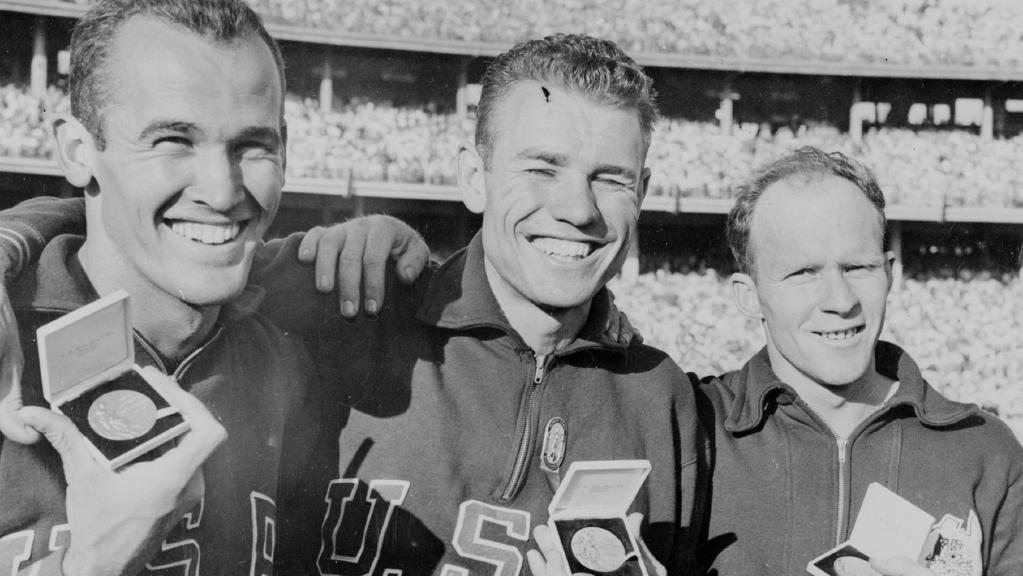
Hec Hogan, right, with his 100m bronze medal and first and second placegetters Bob Morrow and Thane Baker both from the US, at the 1956 Olympic Games in Melbourne. Photo: couriermail.com.au
In contrast to previous Games, many of the competitors decided to stay on in the Melbourne sunshine. This made it possible for a change to the Closing Ceremony that has endured to this day.
A letter from an anonymous “Chinese boy” had landed on the desk of organizing chief Kent Hughes suggesting an unusual parade of the competitors
“War politics and nationality will all be forgotten,” he wrote. “During the march there will only be one nation. What more could anybody want, if the whole world could be made as one nation?”
Long after the Games, the writer was identified as carpentry apprentice John Ian Wing. He had followed the Games on the radio at home and had not seen a single event live. The organizers acted with commendable speed and the march took place as Wing had suggested. It made an immediate impression with some very influential citizens.
“They went around the arena as men and women who had learned to be friends, who had broken down some of the barriers of language, of strangeness, of private prejudices,” said Menzies.
“In the minds of many thousands who saw the Melbourne Games there still lives a green and pleasant memory.”
Organizers set the cost of these Melbourne Games at some $9.8 million. Even allowing for inflation it seemed a remarkable bargain.
From left: Tim Lee, Cobb County chairman; Terry McGuirk, the Braves' chairman; William Rogers, the SunTrust chief executive; Gov. Nathan Deal of Georgia; and the Hall of Famer Hank Aaron break ground for the Braves' new stadium in Cobb County, Ga. in 2014. Photo: John Amis/Associated Press
There are those who really believe baseball is just a sport, like the late Supreme Court Justice Oliver Wendell Holmes who in 1922 said baseball was a sport not an interstate business in the Baltimore Terrapins case against the National and American Leagues and gave baseball the ability to operate as a monopoly.
There are many fans who don’t want to look behind the curtain and just want to be entertained. But Major League Baseball is just a cold and ruthless industry that cares little about fans and loves well-heeled customers. That leads to the not Atlanta-based based Braves now of Cobb County, Georgia. The cable TV industry giant Liberty Media’s John Malone has moved his franchise to suburban Atlanta after 20 years in the 1996 Atlanta Olympic Stadium because Malone and his investors have a chance to make more money.
The country came up with about $376 million to help Malone finance his new factory or stadium. Then came another $10 million for an access bridge for customers to walk over a highway to get to the place. Now comes word that the county plans to build a connector road to the stadium but there is one problem, there are homes in the way and at least 16 homes will be seized by eminent domain with the possibility of 15 more being seized and razed for the road. So people in the neighborhood are being kicked out for the stadium.
The county is hoping to get the construction started next summer or maybe eight months from now. The man who headed the charge for a new Braves stadium, Cobb County Chairman Tim Lee made the deal with Malone and last July voters made their decision to replace Lee. In April, Lee’s project will open much to the delight of Malone and Major League Baseball and some not too happy Cobb County residents.
World Anti-Doping Agency president Sir Craig Reedie. Photo: SkySports.com
Sir Craig Reedie was elected for a second consecutive three-year term as President of the World Anti-Doping Agency (WADA) at the body’s Foundation Board meeting here today, despite the fierce criticism he has been subjected to in recent months.
The 75-year-old Briton was appointed by acclamation as he was the only candidate standing.
Norwegian Sports Minister Linda Helleland was chosen as his vice-president.
Helleland was put forward for the role following an early morning meeting of Government representatives before the crucial gathering of WADA’s 38-strong ruling Foundation Board.
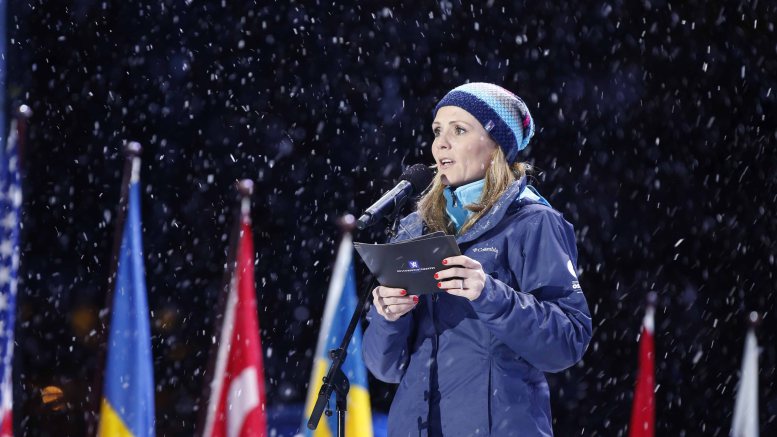
Norwegian Sports Minister Linda Helleland was elected to serve as the vice president of the World Anti-Doping Agency. Photo: Vidar Ruud / NTB scanpix
The 39-year-old takes over a vacant position following the death of South Africa’s Makhenkesi Arnold Stofile in August and becomes a member of the Executive Committee.
Sir Craig was widely thought to be fighting for his future as head of WADA following an unprecedented attack during the Association of National Olympic Committees (ANOC) General Assembly in Doha last week.
A number of officials from the Olympic Movement, including ANOC President Sheikh Ahmad Al-Fahad Al-Sabah, openly criticized Sir Craig and WADA in what represented a continuation of the ongoing feud between the IOC and the anti-doping body.
Tensions surfaced in July when WADA called for a blanket Russian ban from Rio 2016 in response to allegations of state-sponsored doping in the country, including at Sochi 2014.
The IOC rejected this “nuclear option” and instead handed responsibility to International Federations to make decisions on whether Russia should be able to compete.
Sir Craig was ostracized at the IOC Session on the eve of Rio 2016 before another period of public rowing followed in September and October as deliberations took place over how best to reform the global anti-doping system.
“I think my relationship with the IOC has almost always been warm and in an area of partnership,” he said here.
“This was slightly less warm during the ANOC meeting when I received a series of questions normally you would not expect to get from partners.
“But I am really encouraged after the debate we had today.
“If you listen to the discussion, particularly on areas such as compliance and whistleblowing, what we are doing was very strongly supported – not only by the athletes but also the Olympic Movement.
“So I will sleep very comfortably tonight.”
Earlier this month, insidethegames exclusively revealed Sir Craig had been given the endorsement of the IOC Executive Board but they also informed him that they were seeking an “neutral” President of WADA.
The issue was raised here today and a 17-member working group has been established to look into improvements to WADA’s governance, with the idea of a neutral head of the organisation likely to form part of the discussions.
In congratulating Sir Craig on his re-election, the IOC reinforced they were still looking for a change and wanted “to work towards the appointment of a neutral WADA President.”
In a statement, the IOC added: “The IOC congratulates Sir Craig Reedie on his re-election as President of WADA.
“We will be working as part of the Reform Group with our partners, the governments, to deliver an anti-doping system independent of sports organizations and national interests.
“We remain committed to the comprehensive reform of WADA to make it more efficient, transparent and independent.”
Helleland made a bold speech after her appointment as WADA vice-president was confirmed, claiming the “serious doping revelations and violations” have put the credibility of the current anti-doping system into question.
“Doping threatens the basic values of sport,” she said.
“I am strongly committed to the fight against doping in sport and this is my motivation for taking up the position as vice-president of WADA.
“We need to make some bold choices.
“It is crucial we safeguard the independence of WADA and WADA’s capabilities should be strengthened.”
Newly-elected President Kennedy posed for first pictures at his White House desk, January 21, 1961, before plunging into a busy round of conferences. Photo: AP Photo/Bill Achatz
Today marks the 53rd anniversary of the assassination of President John F. Kennedy. The NFL owes much of the league’s success to President Kennedy.
Television money is an essential part of business for sports in the United States. Kennedy signed the Sports Broadcast Act of 1961 into law on September 30 which flipped the sports business. The law allowed leagues to group all of its teams into one entity and sell that one entity to the highest bidder in an auction between TV networks.
In 1961, it was just CBS and NBC that had the money and the wherewithal to fund a sports league. NBC had Major League Baseball at the time and that was only because Major League Baseball had an antitrust exemption and could pool 16, them 18 and 20 franchises as one to sell to a network. The NFL, the NCAA, the NBA and the NHL could not do the same although the NBA and NHL had TV contracts but no one seemed to notice.
The jolting of the NFL and TV came from the most unlikely of places. Branch Rickey’s Continental Baseball League which never got off the ground. Rickey sent his baseball plans to Dallas businessman Lamar Hunt who was more interested in bringing an NFL team to Dallas than fronting a baseball team in a new league.
Hunt never got the NFL team and formed the AFL and borrowed Rickey’s TV plan which called for all teams to share national TV money equally. Hunt’s American Football League cut a deal with the struggling American Broadcasting Company which allowed the AFL’s eight teams to share TV money. NFL Commissioner Pete Rozelle saw what happened and urged his owners to share TV money. Rozelle lobbied Congress to allow shared equally TV money.
The Sports Broadcast Act of 1961 was the most important piece of legislation in the history of American sports.