Home Blog Page 342

Olympic Council of Ireland to Elect New President to Replace Hickey on February 9

0
Olympic Council of Ireland to Elect New President to Replace Hickey on February 9
Patrick Hickey was detained by Brazilian police in August. Photo: AFP

Elections for a new Olympic Council of Ireland (OCI) President are scheduled to take place on February 9 in Dublin, it has been announced.

The vote will take place at a meeting of the body’s ruling Council at the Conrad Hotel in Earlsfort Terrace in the capital city.

There will also be elections for all the other positions on the ruling Executive Committee.

It will mark the start of a re-building process for the OCI following the arrest of longstanding President Patrick Hickey in Rio de Janeiro in August as part of a probe into an alleged ticketing scandal.

Hickey has held the role since 1988 and claimed to be the longest-serving National Olympic Committee President in the world.

Hickey “temporarily self-suspended” himself from all sporting positions following his arrest and – with the official still in the process of leaving Brazil on bail – is not expected to return to the role anytime soon.

The OCI vice-president position relinquished by Football Association of Ireland chief executive John Delaney is also available.

Treasurer Kevin Kilty, the Chef de Mission for the Rio 2016 Games, and Crisis Management Committee member Ciaran O’Cathain have also resigned to leave additional vacancies.

Willie O’Brien is currently serving as interim-President.

Nominations for all positions are due to close on January 11.

Hickey, who has also vacated his European Olympic Committees Presidency, was charged with various ticketing offence by Brazilian authorities, which reportedly include criminal organization, ticket touting, ambush marketing, larceny, money laundering and tax evasion.

The 71-year-old denies all the charges against him and earlier this week a judge in Brazil agreed to return his passport so he could leave the country for medical treatment.

Bail money amounting to $440,000 has been paid in a loan by the Association of National Olympic Committees, of which Hickey was first vice-president.

Hickey’s lawyer Arthur Lavigne has told the Irish Times today that Hickey is now in possession of his passport and, as far he knows, “has already left Brazil, and is on his way home.”

By Nick Butler

Republished with permission from insidethegames.biz

A Million Kinds of Worth It: My Thank You Note to USSA

0
A Million Kinds of Worth It: My Thank You Note to USSA
Officials of the United Arab Emirates (UAE) and the United States Sports Academy recently celebrated the Opening Ceremony for the UAE Football Association (UAEFA) Academy for Sports Management (FAASM), known as the Football Association Academy (FAA). The new project is dedicated to the development of football (soccer) administrators in the UAE through a Football Club Operators License Program being offered cooperatively by UAEFA and the United States Sports Academy. The opening was held 24 April in Abu Dhabi. Shown left to right are Majid Abweh, Development Officer for the Fédération Internationale de Football Association (FIFA); H.E Yousef Yaqoob Al Serkal, UAEFA President; Stuart Larman, Head of Development for the Asian Football Confederation; Dr. Brandon Spradley, United States Sports Academy Director of Sports Management and Alumni Association Executive Director; Raymond Verheijen, Chief Executive Officer of the World Football Academy; H.E. Sheikh Nahyan bin Mubarak Al Nahyan, UAE Cabinet Member, Minister of Culture and Knowledge Development, and Chairman of the General Authority for Youth and Sports Welfare; Alexandre Gros, Manager of Development Asia at FIFA; H.E. Obaid Salem Al Shamsi, FAA Chairman; and Abdulla Al Ahmed, Senior Vice President for Business at Etisalat, the Emirates Telecommunications Corporation.

The contest. The examination. The battle against resistance – these are the things that sports helps us through. In overcoming, through the struggle – we can come to know that to journey is better than to arrive. This is an amazing lesson we learn, in big or small ways, through any type of participation in sports and recreation.

We can all identify with this, right? So, let’s give it a little context:  End of the semester madness. Across the world, from kindergarten to college, students are crushing to the end of their fall semester. Final exams loom. Final projects press and stretch individual ability. And among the varied student populations, kiddos of all shapes and sizes head down the grass, or through the snow, at charge speed – seemingly all with their hearts banging against their throats! Why? They are under the stress of examination. They are under the stress of justification. They are under the stress of the measurement of their skills, talents, and abilities – against a standard.

Adults who’ve been away from school may think back and miss those times, and are likely relieved not to have to go through them again. They’ve crossed the threshold – and lived past all that. They may still be tested or examined – but not like at school, so much. Yet, we all remember how the end-of-the-semester madness had a way of making our faces look older and strained – smeared with the scraps of expressions that were pressed on too hard and wouldn’t lift away – until that last bit of the school semester was complete.

I remember during finals week I used to tell myself – “ok, in four or five days this will all be over.” And then, when it was over – whoooo whooooooooo! What a great relief! And it recently occurred to me – that this dynamic has helped shape the joy of Christmas time, for generations! No matter what our role in this process now, whether as a student directly facing the press, or as an instructor under similar demands of grading, or as a parent of students squalling about the times, or as an outside observer relishing the “been there, done that” – no matter what our role, if we think about it in the right way…though the exercise of the end-of-the-semester madness can be exhausting, and throttle our fears – we realize, we need it like a drug.

In a parallel experience, I have recently had the opportunity to work with a range of adults seeking soccer certification in the United Arab Emirates (UAE). As such, I’m writing this note from Dubai, where we have just concluded a course that will enable the participants to enhance their efforts and improve their individual and collective perspective on the administration of sports in the UAE. I’ll be heading back to the states later today, and remarkably, what I’ll take back with me is overflowing…

Ever seeking the chance to appreciate the diversity of others, this trip has been, for me, a delight at max load. But, what a fine time to be displaced from the celebrations of home, to temporarily root up, and to travel half way around the world, eh? Well, I said “yes!” to that – and for that answer I have been gifted with an incredible learning experience. As the instructor in this scenario here, it is I who have taken a lesson. These charming Arabians have taught me – of the joys of their culture, of their lavish generosity, of their truly enchanting displays of affection, and of the tremendous value they have for others.

As I continue to reflect, I am certain that many more lessons will appear. But perhaps what is most profound is that I have been overwhelmed in the most positive sense – of the great value of learning to appreciate the differences of other people. Yes, it is a confirmation – of sorts – for I have long preached of our need to value the differences in others. And I truly see that as a major part of the solution to most of what ails our aching planet. So here, under the Arabian sun – having glimpsed these beautiful people – the world now seems bigger for me somehow. And the echoes of this will stay with me forever. Without doubt, this trip has been – a million kinds of worth it!

By Dr. Rodney J. Blackman

Dr. Rodney J. Blackman is the Chair of Recreation Management at the United States Sports Academy, and can be reached at [email protected].

American Softball Veterans Reunite for Game to Mark Sport’s Entry into Olympic Program

0
American Softball Veterans Reunite for Game to Mark Sport’s Entry into Olympic Program
Former and current Olympic softball players from the United States, with 36 Olympic medals between them, reunited for an exhibition game at the University of New Orleans. Photo: USA Softball

Nineteen former and current Olympic softball players from the United States, with 36 Olympic medals between them, have reunited for an exhibition game at the University of New Orleans.

The match represented not only a celebration of the 20th anniversary of softball’s entrance into the Olympic program, but also the sport’s return to the Olympic Games in 2020 after being left out of the last two Games.

It brought together Olympians from all four squads of Atlanta 1996, Sydney 2000, Athens 2004, and Beijing 2008 in which the American team won gold at three and lost to Japan in the final in the Chinese capital.

Opposing the Olympians were a team called the Louisville Slugger Warriors, a group of US military service members and veterans.

The team composed of injured veterans and active duty military personnel with both physical wounds, who are aided by modern prosthetic technology, and invisible wounds including Post Traumatic Stress Disorder (PTSD).

“Time has passed but you reconnect like nothing ever happened,” said Laura Berg, Team USA’s only four-time softball Olympian.

“We share something that very few people will ever will able to experience.

“It’s a sisterhood. We have friendships that will last a lifetime because of that bond.”

Berg joked that she has won “three gold medals and one silver that we don’t like to talk about,” referencing the runner-up finish to Japan in Beijing.

Despite that one blemish, the US enjoyed dominance in the sport thanks in large part to the group of players on show in New Orleans.

For Monica Abbott, the youngest team member in 2008, a return to Olympic competition for the 2020 Tokyo Games is a possibility.

“If I can still compete at the highest level, I would like to represent Team USA and help it compete at the highest level in Tokyo in 2020,” said Abbott, now 31 and playing in the sport’s professional league, National Pro Fastpitch.

“In 2020, obviously I would be one of the oldest and that would be a total role reversal.”

Amateur softball has continued to grow in the US, even during the sport’s absence from the Olympic Games.

The Women’s College World Series in Oklahoma City has become a significant event on the calendar, as has the World Cup of Softball, held every summer in the US.

The Olympians agreed that the return to Olympic competition as a motivating force for youngsters can only accelerate the sport’s growth.

“I have so many wonderful memories from being in the Olympic Village to the Opening Ceremony and competing on that stage,” said Lisa Fernandez, a three-time Olympian who was on the first US Olympic team in 1996.

“There’s nothing like the adrenaline, the energy, the commitment and the pride that you have when America comes together and the softball community comes together.

Fernandez said she senses an excitement surrounding softball’s return to the Olympics, similar to the one she experienced when it debuted 20 years ago

“I think everyone is coming in with renewed excitement and renewed vigor,” Fernandez said.

“We were disappointed when it was taken out and now that it’s coming back we’re rejuvenated.

“You appreciate the opportunity to represent the red, white and blue unlike any other.”

By Max Winters

Republished with permission from insidethegames.biz

NBA Players Want to Know Why 18-Year-Olds Barred from the League

0
NBA Players Want to Know Why 18-Year-Olds Barred from the League
Nov 16, 2016; Orlando, FL, USA; Orlando Magic forward Aaron Gordon (00) high fives center Nikola Vucevic (9) against the New Orleans Pelicans during the second half at Amway Center. The Magic won 89-82. Mandatory Credit: Kim Klement-USA TODAY Sports

National Basketball Association owners and players are in negotiations for a new collective bargaining agreement and an old subject is on the table: What should be the minimum age of a player entering the league?

The owners think 20 years of age and two college seasons is appropriate, while the players think if there is, say, another Kobe Bryant or LeBron James out there at 18, why should they be denied entry? It has been a point of contention for decades now and the owners and players about 10 years ago, raised the age of the minimum to 19 and only year of school or in case of foreign players 19 and some development.

Money was the real reason the owners wanted the age restriction. It was not the rookie contract that bothered the owners, it was the second contract. The thinking was this. If the owners could push back the age minimum, they could also push back the time when a player could become a free agent whether it was restricted after three years or full free agent after four seasons. It’s easier to evaluate a slightly older player when it comes to offering that player a second contract.

The owners would also get free research and development from colleges and universities. Players can get better or worse in the college game and NBA owners didn’t have to pay them millions to learn the business. Former Commissioner David Stern wanted his scouts out of high school gyms, the US military has been busy at high school facilities trying to recruit soon to be 18-year-old graduates to sign up for service.

Stern didn’t think the NBA is the right environment for an 18-year-old, but the United States military has no problems signing up an 18-year-old and recruiting on a high school campus.  The priorities seem to be out of whack. Even David Stern understood that.

By Evan Weiner For The Politics Of Sports Business

This article was republished with permission from the original publisher, Evan Weiner.

Gretchen Kelsey Brown Receives United States Sports Academy Distinguished Service Award

0
Gretchen Kelsey Brown Receives United States Sports Academy Distinguished Service Award
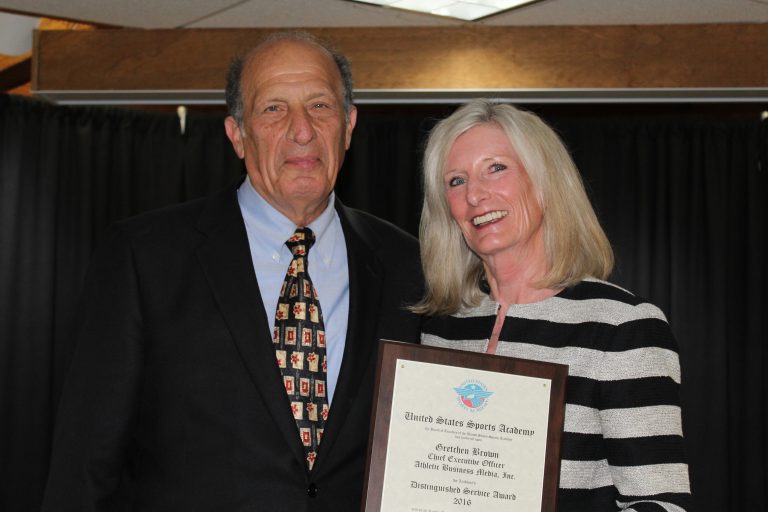
Gretchen Kelsey Brown, co-founder of Athletic Business magazine and chief executive officer of Athletic Business Media, Inc., recently was presented the United States Sports Academy’s 2016 Distinguished Service Award by Academy trustee Dr. Nick Niccolai during the Academy’s 32nd annual Awards of Sport Program held recently on campus.

Gretchen Kelsey Brown, co-founder of Athletic Business magazine and chief executive officer of Athletic Business Media, Inc., has been presented the United States Sports Academy’s 2016 Distinguished Service Award (DSA).

Given for outstanding contributions to sport, the award was presented recently on campus as part of the Academy’s 32nd annual Awards of Sport program. Brown received the award from Academy trustee Dr. Nick Niccolai.

After graduation from the University of Wisconsin-Madison in 1973 with a bachelor’s degree in communication arts, Gretchen Kelsey joined the family publishing business.  In 1976 she and her father, Fenton Kelsey Jr., launched Athletic Purchasing & Facilities magazine (AP&F), the precursor to Athletic Business.  AP&F focused on sports facility construction and management.  In 1980 the publication name changed to Athletic Business to reflect the broadening reach of the editorial content.  The magazine and parent company, Athletic Business Media, Inc., are based in Madison, Wisc.

Athletic Business is read in print by more than 40,000 subscribers representing colleges and universities, high schools, park and recreation departments, military branches and bases, health clubs, YMCAs, professional sports teams, stadiums and arenas, sports architecture firms, and hospital and corporate wellness centers.

In recent years Athletic Business has expanded into digital media and live events. The Athletic Business electronic newsletter is read daily by more than 40,000 subscribers and the Athletic Business website attracts more than 200,000 visitors each month.

Athletic Business has been at the forefront covering key issues including the growing recognition of the importance of fitness, the mandated inclusion of women’s and girls’ sports programs through Title IX, and the growing demand for and sophistication of athletic, recreational and sports facilities.  Athletic Business in 2015 partnered with the National Center for Spectator Sports Safety & Security (NCS4) covering the many concerns related to safety and security.

Athletic Business has won numerous awards for its journalistic content, including a commendation from the President’s Council on Physical Fitness for groundbreaking reporting on the birth of corporate fitness and the wellness movement.  The magazine also heavily reported on issues surrounding sports product liability and safety, receiving special recognition from the Sporting Goods Manufacturers Association.

Athletic Business each year gives Athletic Business Facility of Merit Awards recognizing the best in new facility design and construction as judged by a panel of leading sports facility architects.

Athletic Business produced the first Athletic Business Conference in 1982, attracting representatives from colleges, park and recreation departments, the military and private sports and health clubs.

When Kelsey married Peter Brown in 1986, he joined the company, taking over management of the Athletic Business Conference and growing it to today’s premier facility-focused event, attracting more than 2,500 attendees and 500 exhibit booths annually.  He is currently president of Athletic Business Media, Inc.

Athletic Business Media also publishes Wood Floor Business Magazine, the leading publication for the wood flooring industry, and AQUA magazine for the pool and spa industry. Both are leaders in their industries and have vibrant digital components.

Each year the United States Sports Academy presents its Distinguished Service Award to individuals who have made outstanding contributions to national or international sports through instruction, research or service.  Those selected must possess an extensive background in sports. This means that the individual must have had significant dealings in either instruction, research or service in sports for more than 10 years. The award is part of the Academy’s Awards of Sport, which each year honor a wide range of accomplishments in sport and serve as “A Tribute to the Artist and the Athlete,” in conjunction with the Academy’s American Sport Art Museum and Archives (ASAMA).

Based in Daphne, Ala., the United States Sports Academy is an independent, non-profit, regionally accredited, special mission sports university created to serve the nation and world with programs in instruction, research, and service. The role of the Academy is to prepare men and women for careers in the profession of sports. For more information about the Academy, call (251) 626-3303 or visit www.ussa.edu.

By Keith Ayers

Keith Ayers is the Director of Communications at the United States Sports Academy. Reach him at [email protected]

US Olympic Committee to Increase Pay for Medal Winners at Major Competitions

0
US Olympic Committee to Increase Pay for Medal Winners at Major Competitions
United States' Simone Biles smiles on the podium after winning vault gold during the artistic gymnastics women's apparatus final at the 2016 Summer Olympics in Rio de Janeiro, Brazil, Sunday, Aug. 14, 2016. (AP Photo/Dmitri Lovetsky)

American athletes are set to see their accomplishments recognized more than ever as the United States Olympic Committee (USOC) is increasing its Operation Gold payments to medal winners.

As part of a continued effort to direct more resources to athletes, USOC announced that money paid to athletes will increase “significantly” for the 2017-20 quadrennium.

Operation Gold provides monetary rewards to athletes who earn medals at the Olympic and Paralympic Games, as well as World Championships.

Payments at the Pyeongchang 2018 Winter Olympics will increase by 50 percent after American success at Rio 2016, where the country won 121 Olympic medals and 115 at the Paralympics.

The Olympic tally was the highest the country as ever earned at a non-boycotted Games.

Money paid for World Championship medals in non-Games years will increase by 25 percent.

Athletes will receive $37,500 for each gold medal earned at the Olympic Games, $22,500 for silver and $15,000 for bronze.

Medalists at the Paralympic Games are set to earn $7,500 for gold, $5,250 for silver and $3,750 for bronze.

Earlier this week, the winners of the USOC Best of the Month awards for November were announced.

Paralympic snowboarder Mike Minor, fencer Anna van Brummen and the women’s ice hockey team all scooped prizes.

Minor, who is participating in just his second season at international level, won the men’s prize after he secured back-to-back wins at the International Paralympic Committee (IPC) Para Snowboard World Cup in Landgraaf in The Netherlands.

Van Brummen was the recipient of the women’s award following a successful November, during which she caused a huge upset by winning the women’s épée title at the International Fencing Federation World Cup in Suzhou in China.

The women’s ice hockey side claimed the team prize after retaining their Four Nations Cup title in Jarvenpaa in Finland.

By Max Winters

Republished with permission from insidethegames.biz

Olympic Champion Kipchoge Among Nike Athletes Targeting Sub Two-Hour Marathon

0
Olympic Champion Kipchoge Among Nike Athletes Targeting Sub Two-Hour Marathon
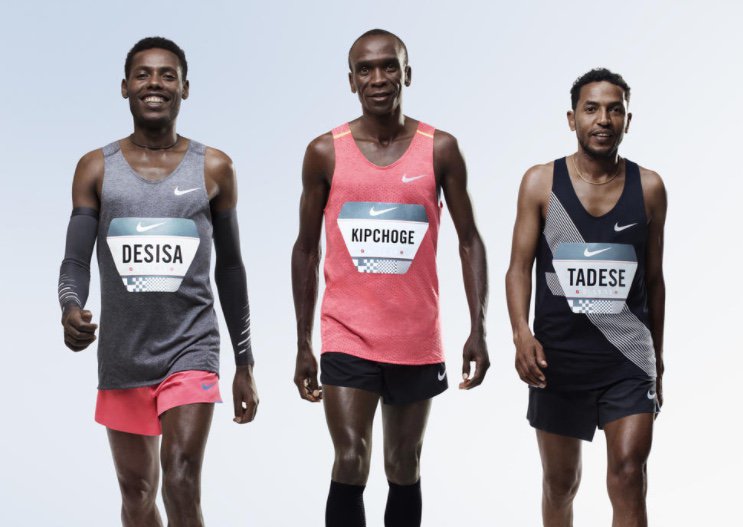
Lelisa Desisa, Eliud Kipchoge and Zerseney Tedese are all targeting a sub-2 hour marathon. Photo: Nike

Nike has unveiled an ambitious new project designed to achieve the “impossible” time of a sub two-hour marathon in 2017.

Olympic champion Eliud Kipchoge will be among those taking on the challenge as part of the “Breaking2” project, alongside Eritrea’s Zersenay Tadese and Lelisa Desisa of Ethiopia.

The clothing giants will work with a “diverse team of leaders across several fields of science and sport with a holistic approach to athletes, product, training, nutrition and environment.”

No exact time or location has yet been finalized for their attempt, but it is expected to take place at some-point in the spring on a “non-legal” course.

This means that Nike can introduce aspects not allowed in competition in a bid to produce a quicker time.

It is not yet clear exactly what this will consist off, but a looped, downhill course with unlimited refreshments and controlled pacemakers have been mooted.

It is possible that vehicles could act as pacemakers as well as a team of supporting runners.

A three per cent improvement on Dennis Kipruto Kimetto’s 2014 mark of 2hours 2min 57sec is required to break the two hour mark.

This would require a stunning average time of 4:41 for each mile

“Many consider this feat impossible,” said Nike today.

“However, that challenge is exactly what drives Nike; the impossible is an opportunity to envision the future of sport.

“To help achieve a sub two-hour marathon, Nike is working with a diverse team of leaders across several fields of science and sport with a holistic approach to athletes, product, training, nutrition and environment.

“Breaking2 provides an opportunity to explore whether the impossible is within reach.

“It is the ultimate embodiment of Nike’s mission: To bring inspiration and innovation to every athlete on the planet.”

Kipchoge has been one of the world’s most successful distance runners over the last 13 years after winning the world 5,000 meter title as a teenager in 2003.

He won April’s London Marathon in a staggering time of 2:03:05 before his Olympic success.

Tadese, the first Eritrean Olympic medalist when winning the 10,000 meter bronze at Athens 2004, has won world titles on the road and in cross country as well as holding the current half marathon world record of 58:23.

Desisa is a two-time Boston Marathon winner who ran 2:04:45 on his marathon debut in Dubai in 2013.

None of these three runners are expected to run a sprint marathon on the World Marathon Majors circuit as they prepare for the Nike challenge.

The project has been dismissed as a gimmick by some, however, with critics claiming any result would be meaningless whenever race-rules are not applied.

“If you take Eliud Kipchoge, or [Ethiopian rival] Kenenisa Bekele, and they become only a little bit stronger than they are right now, and you take them to run a marathon that is 50 meters below sea level, and for a pacesetter you have a car or motorbike, or something like this, that is normally allowed in current competitions, and you also allow them refreshment, not every five kilometers like the rules state but whenever they need it, I think that such a time is already possible,” marathon coach Renato Canova told LetsRun.

“But, this situation is not athletics.

“I guess it depends on what is the final goal for the project.

“If the final goal is only running under 2:00, I suppose it’s possible in two to three years.

“But if the goal is to run under 2:00 in a normal marathon, then no, it’s not possible.”

By Nick Butler

Republished with permission from insidethegames.biz

Russian Teams Won’t Boycott IBSF World Championships After Relocation from Sochi

0
Russian Teams Won’t Boycott IBSF World Championships After Relocation from Sochi
The Russian bobsleigh and skeleton national teams will not be boycotting the 2017 World Championships according to Alexander Zubkov, the president of the Russian Bobsleigh Federation. Photo: Lionel Bonaventure, AFP

The Russian bobsleigh and skeleton national teams will not be boycotting the 2017 World Championships, which will be relocated from the 2014 Olympic host city of Sochi, according to Alexander Zubkov, the president of the Russian Bobsleigh Federation.

“I give you a 100 percent guarantee that we will not be boycotting the bobsleigh and skeleton world championship, which will not be held in our country,” Zubkov told the TASS news agency. “We will come and prove that we are able to fight at any championship. We will also prove that we are the world leaders and will be fighting for medals.”

The International Bobsleigh and Skeleton Federation (IBSF) announced on Tuesday its decision to relocate the 2017 World Championships from Sochi to another venue, which would be determined by the end of the week. The decision was made in light of numerous allegations on doping abuse and manipulations in Russian sport.

This story first appeared in the blog, The Sport Intern. The editor is Karl-Heinz Huba of Lorsch, Germany. He can be reached at [email protected]. The article is reprinted here with permission of Huba. 

Army-Navy Game Available to the Highest Bidder Starting in 2018

0
Army-Navy Game Available to the Highest Bidder Starting in 2018
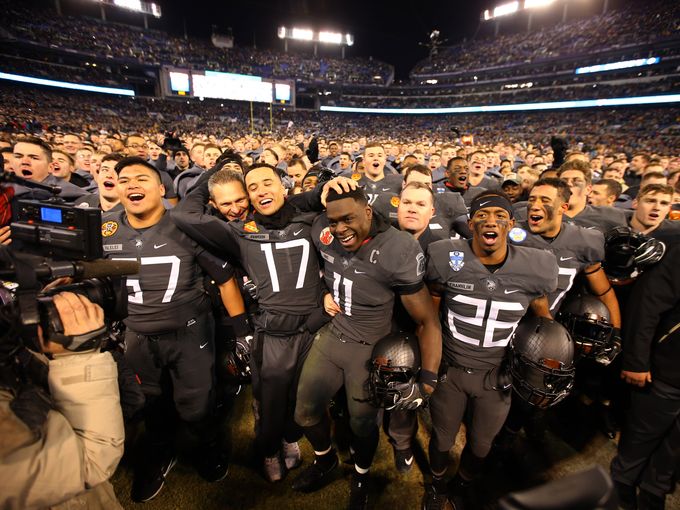
Army defeated Navy for the first time in 14 games on 11 December, 2016 in Baltimore. Photo: Danny Wild, USA Today Sports

There are those who hold the annual Army-Navy game dear and think it is a throwback to different times when college players performed for the love of the game. But it is business as the United States Military Academy and the United States Naval Academy have a for sale up with the Army-Navy football game available to the highest bidder beginning in 2018.

This year’s contest was played in Baltimore and next year’s game will go back to Philadelphia. Last Saturday’s matchup was the 117th meeting of the two service academies with Philadelphia hosting 86 games and that makes sense since Philadelphia is nearly half way between the two schools.

Baltimore has had the game 10 times. The game was split between West Point, New York and Annapolis, Maryland in the first four meetings in the 1890s. Though mostly an eastern seaboard affair, the game has been played in Pasadena, California once.

Baltimore, Seattle, San Diego, Arlington, Texas, Houston, Pittsburgh, Philadelphia, East Rutherford, New Jersey, Foxboro, Massachusetts and Dan Snyder’s NFL Maryland stadium outside of Washington are on the list, although San Diego does not have an NFL state of the art stadium and won’t when all the bids are reviewed and the 2018 game and games that will take place afterwards are handed out.

The service academies are looking at stadiums that hold at least 70,000 people. There was a report in the Baltimore Business Journal that studies have concluded the game generates $30 million worth of economic impact in the host city. However, there is no concrete evidence that this one day sporting event brings in that much cash.

Army-Navy is not a must-see contest. Cities will make their multimillion dollar bids because elected officials feel there is something to gain getting the Army-Navy football game. And the players will not get paid despite all the money around.

By Evan Weiner For The Politics Of Sports Business

This article was republished with permission from the original publisher, Evan Weiner.

USA Hockey, USOC Discuss ‘Plan B’ for 2018 Winter Olympics Participation if no NHL Deal Reached

0
USA Hockey, USOC Discuss ‘Plan B’ for 2018 Winter Olympics Participation if no NHL Deal Reached
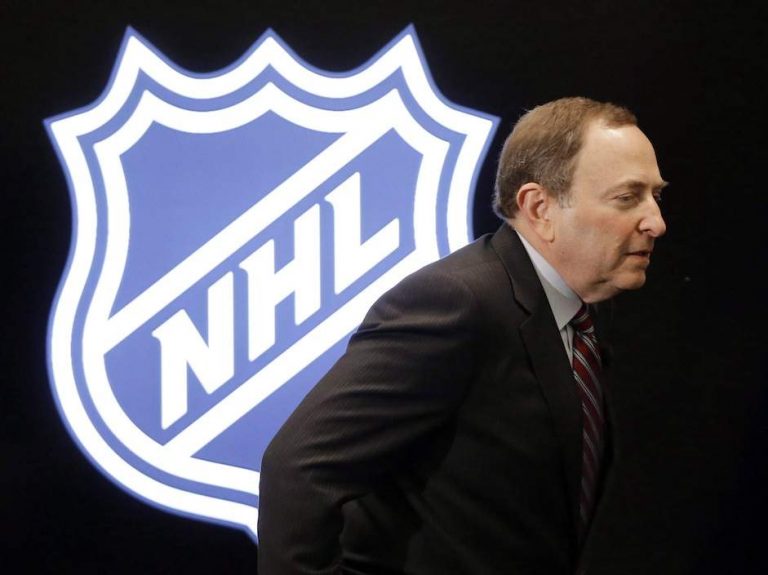
NHL commissioner Gary Bettman. Photo: Mark Humphrey/The Associated Press

United States Olympic Committee (USOC) officials have discussed a “Plan B” with USA Hockey over how they will participate at the Pyeongchang 2018 Winter Olympic Games if players from the National Hockey League (NHL) do not compete.

Top stars from the NHL, the world’s largest league, have participated in the last five Games since first appearing at Nagano 1998.

However, reaching a deal for the Korean Games is proving harder than ever after the International Olympic Committee (IOC) opted not to cover the cost of transportation and accommodation fees as they previously had.

NHL commissioner Gary Bettman claimed last week how team owners are showing a “strong negative sentiment” and are showing signs of “fatigue” after appearing at the five previous editions.

The NHL would have to shut down for two weeks in order for its players to compete at the Games – scheduled to take place from February 9 to 25 – and the league has said previously it would like to make a decision by January 2017.

If no deal is reached, the US team would consist of players from collegiate-level and minor leagues.

“We have had discussions with USA Hockey about a Plan B if that does not happen,” USOC chief executive Scott Blackmun was quoted as saying by Reuters.

“Obviously it creates more challenges for them and for us from an organisational standpoint, we’re still very hopeful the NHL players will be there.

“We know they [players] want to be there and we understand the challenges it creates for the league.

“We are certainly exploring all avenues that would allow that to happen.”

Accommodation and transportation costs are estimated to total around $10 million due to the long flights involved to Korea.

International Ice Hockey Federation (IIHF) President René Fasel claims he will be able to raise the money himself through IIHF funds and by soliciting help within the sport and from other supporters.

But others are worried that, by calling on bodies like USA Hockey to contribute, funds could be diverted from grassroots development programs.

IOC President Thomas Bach claimed earlier this month that it was in the “interest of all parties” to see athletes from the league represent their countries at Pyeongchang 2018.

An agreement was only reached for Sochi 2014 just seven months before the Opening Ceremony, so time does remain to hammer out a deal.

But a latest attempt to reach an agreement failed earlier this month.

Don Fehr, executive director of the NHL Players’ Association (NHLPA), confirmed how the body had formally turned down a deal which would have permitted Winter Olympic participation in return for an extension to their current collective bargaining agreement.

This was last negotiated during a strike that led to almost half of the 2012-13 season being missed and is due to expire in 2022.

NHL officials were hoping to use the Pyeongchang carrot to force an extension until 2025.

Almost all countries due to compete at the Games would be hit by the absence of NHL players, although the US and Canada would be especially affected.

By Nick Butler

Republished with permission from insidethegames.biz