Home Blog Page 341

Alan Hubbard: Murray Simply the Best in 2016 – But of All Time? Not in My Book
0
Alan Hubbard: Murray Simply the Best in 2016 – But of All Time? Not in My Book
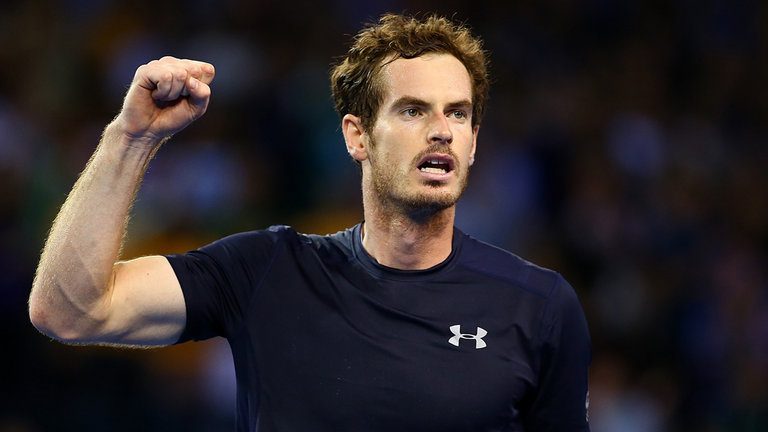
Andy Murray. Photo: Sky Sports

Barring a massive computer cock-up or a questionable slice of rank injustice, Andy Murray will be crowned the BBC Sports Personality of the Year on Sunday (December 18) for the third time, and rightly so. It is a no-brainer after the fabulous year he has had.

When he won Wimbledon in 2013, Murray ended a 77-year wait for a home-grown male champion and he repeated his triumph this year. He has also made history as the first player to retain an Olympic singles title. His 44 career titles leave him well out in front of the British competition, and his three majors place him in elite company worldwide.

That is why he also got my vote as Sportsman of the Year in the annual Sports Journalists Association poll.

And it is believed he has been nominated for a knighthood in the New Year Honors.

He deserves that too.

But incredibly, in my book, he has also been named as the UK’s Sportsperson of All Time in a poll conducted by the Daily Telegraph newspaper.

Of all time? Surely not?

Much as I admire Murray I simply cannot believe that! Can you?

In front of Sir Bobby Charlton, named at number two, better than Daley Thompson, listed at number three, and Sir Ian Botham, at number four. And most astonishingly of all, better than Sebastian Coe.

His Lordship comes in at only number 16 in the list of 100 of the all-time best of British.

Coe’s citation reads: “Graceful, elegant, jet-heeled, he was a pioneer of proper training methods long before the days of maximizing marginal gains. A captivating middle-distance runner in his pomp, winning successive 1,500m titles in 1980 and 1984 and forging a compelling rivalry with Steve Ovett (named at No 95 incidentally).

“His stewardship of London 2012 was achieved with the same apparently effortless ease.”

Moreover those Olympics surely were Britain’s finest sporting accomplishment and his contribution in winning them for London and orchestrating their success was immense.

And now he heads the world’s largest sporting body in terms of global membership, the International Association of Athletics Federations (IAAF).

Yet apparently this does not qualify him, according to the Telegraph’s jury, of being placed higher than a clutch of sporting knights including Sir Bradley Wiggins, Sir Steve Redgrave and Sir Nick Faldo. What? Sir Nick Faldo? You have got to be joking.

Sebastian Coe. theolympians.co

If that is a slight to Lord Coe then how about Sir Alf Ramsey, the man who masterminded England’s only football World Cup victory? He does not even make the cut.

Neither does Charles Burgess Fry. He was an English sporting all-rounder as well as a politician, diplomat, academic, teacher, writer, editor and publisher, who is best remembered for his career as a cricketer.

The great scribe and commentator John Arlott described him thus: “Charles Fry could be autocratic, angry and self-willed: he was also magnanimous, extravagant, generous, elegant, brilliant – and fun…he was probably the most variously gifted Englishman of any age.”

Fry’s achievements on the sporting field included representing England at both cricket and football, an FA Cup final and equaling the then-world record for the long jump. He was also a rugby player and renowned acrobat who reputedly turned down the throne of Albania.

In later life, he suffered mental health problems, but even well into his 70s he claimed he was still able to perform his party trick: leaping from a stationary position backwards onto a mantelpiece.

At Oxford he gained a total of 12 sporting Blues for representing his university, and in one year he captained the football, athletics and cricket teams. To fill in time he also played rugby union at university, as well as for Blackheath and the Barbarians. In addition he proved himself to be a fine boxer, golfer, swimmer, tennis player, javelin thrower and sculler.

Murray is the only tennis player among the Telegraph’s top 50, yet it is arguable that he is not Britain’s greatest to grace the courts.

Fred Perry is ranked at number 52 yet he won eight major titles, including three straight Wimbledon Championships from 1934 to 1936. He won all four Grand Slams in a four-year period, was world number one and helped Britain to four Davis Cups.

Times were different then of course. Maybe the competition was not as intense but today’s facilities, training methods, diets and living standards are far better…as are the rewards.

The selection process included 13 expert sporting panelists, along with Telegraph sports writers, choosing their top 20 lists. A second element was to invite the public to participate. Correspondents each picked up to 20 contenders in each sport or area, and then readers were asked to vote in an online poll with more than 6,700 subscribers taking part.

With Murray, you can throw in a US Open title as well as his colossal contribution to Britain’s return from the wastelands of the Davis Cup.

It is likely you have heard of most of the likely suspects on the 100-strong list which is liberally sprinkled with lords, knights and dames. From Sir Chris Hoy, Jason Kenny, Mo Farah, Bobby Moore (but no Sir Geoff Hurst), Sir Roger Bannister and Sir Bradley Wiggins to W.G Grace, Sir Ben Ainslie, Sir Steve Redgrave, Sir Matthew Pinsent, Jonny Wilkinson, George Best, John Charles, Baroness Tanni-Grey Thompson and Laura Trott, to name but a few. As well as darts czar Phil Taylor, at number 25, and snooker’s Ronnie O’Sullivan at number 63.

But some are less familiar, like Welsh-born Paulo Radmilovic, at number 94, whose four golds in water polo and swimming across three successive Olympics set a standard not broken for 80 years. Only the First World War, which arrived between his second and third Games, denied him winning more.

Born in Cardiff in 1886, son of a Croatian father and Irish mother, Radmilovic won four gold medals in a remarkable 20-year Olympic career spanning five Games in swimming and water polo.

Then there was a real pioneer of boxing in the 18th century, Jack Broughton at number 66. “The Broughton Rules” contributed to the development of “The Marquis of Queensbury Rules”, still used worldwide today.

Broughton, undefeated in his incredible 42-year career, also invented the first form of padded boxing glove.

From numero uno Murray through to Jimmy Greaves at number 100, the list is absorbing, controversial and doubtless will be the subject of arguments and debates in clubs and pubs as the sporting year closes.

For the record the Telegraph’s top ten are: Andy Murray, Sir Bobby Charlton, Daley Thompson, Sir Ian Botham, Mo Farah, Sir Steve Redgrave, Sir Tony McCoy, George Best, Sir Bradley Wiggins and Sir Chris Hoy.

Oddly, not a female among them. The highest is 12th-placed Jess Ennis-Hill, one below Faldo.

But I seriously doubt even the modest Murray himself would really consider himself as Britain’s greatest ever sports figure.

Surely that has to be Coe?

By Alan Hubbard

Republished with permission from insidethegames.biz

Hickey Leaves Brazil for First Time Since Rio 2016 Arrest

0
Hickey Leaves Brazil for First Time Since Rio 2016 Arrest
Patrick Hickey. Photo: sportal.co.nz

Patrick Hickey has left Brazil for Ireland for the first time since his arrest during the Rio 2016 Olympic Games.

The Olympic Council of Ireland (OCI) and European Olympic Committees (EOC) President was apprehended by police during a dawn raid on August 17 and has remained in the country since then.

He was charged with various ticketing offenses, which reportedly include criminal organization, ticket touting, ambush marketing, larceny, money laundering and tax evasion.

Seventy-one-year-old Hickey denies all the charges against him and received good news last month when a judge in Brazil agreed to return his passport so he could leave the country for medical treatment.

According to The Journal, he boarded a flight in Rio de Janeiro yesterday evening and should arrive home today.

He made no comment at the airport and went straight through the security gates.

Hickey has reportedly already booked himself in for heart surgery in Ireland.

A condition of having his passport returned was paying a court bond of $440,000.

Earlier this month the The Association of National Olympic Committees (ANOC), of which Hickey is a vice-president, agreed to loan him the money.

ANOC said they made their decision on “humanitarian grounds” with the decision unanimously approved by President Sheikh Ahmad Al-Fahad Al-Sabah and all vice presidents via a postal vote.

“The terms of the temporary loan make it clear that it must be repaid to ANOC in full,” a statement said.

When ruling that Hickey’s passport should be returned, Justice Juliana Leal de Melo said that the risk that he may not return to Brazil was countered by his health concerns.

The Irishman was initially held in Rio de Janeiro’s Bangu Prison during his time in Brazil.

He has stepped down from all of his sporting roles temporarily while the saga has unfolded.

An OCI statement said: “We in the Olympic Council of Ireland are treating Pat’s movements as a private matter for him, his family and his medical advisers.”

Yesterday, the OCI revealed that Hickey would be replaced as President during an election on February 9.

“For clarity, as Pat Hickey has repeatedly advised in the past year prior to the Rio Games 2016 he would be finishing his term of office after the Games,” a statement said.

By Dan Palmer

Republished with permission from insidethegames.biz

Olympic Council of Asia Open Door for Surfing to be Included at 2018 Asian Games

0
Olympic Council of Asia Open Door for Surfing to be Included at 2018 Asian Games
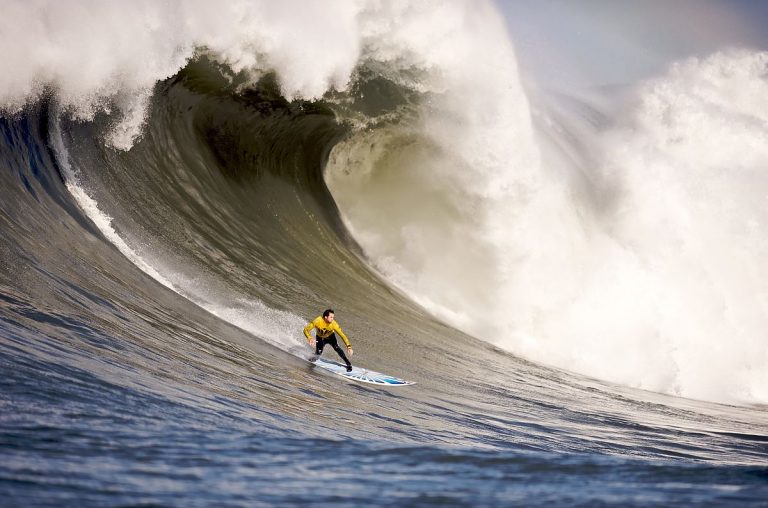
Photo: Mavericks Surf Contest 2010, by Shalom Jacobovitz - via Wikimedia Commons.

Surfing may yet be added to the program for the 2018 Asian Games after organizers confirmed they were trying to “find a solution” to get the sport included at the event in Jakarta and Palembang.

The development follows the fifth meeting of the Olympic Council of Asia (OCA) Coordination Committee for the Games, chaired by International Olympic Committee (IOC) member Tsunekazu Takeda.

The OCA has confirmed 41 sports will feature at the event in Indonesia.

Surfing, which will make its Olympic Games debut at Tokyo 2020, had initially been left off the program in September.

Both surfing and skateboarding were set to be excluded before it was agreed the latter sport should be included following a meeting between the Organizing Committee and Jakarta 2018.

The OCA have admitted there are “minor technical issues with the International Surfing Association (ISA) and Organizing Committee” concerning the “venue and logistics” of holding the sport at the event.

It was initially suggested there were no appropriate venues in either Jakarta or Palembang.

An alternative location, like Bali, was ruled too much of a logistical difficulty due to its location almost 600 miles away.

They claim, however, that they have the option of finding a solution to include surfing, raising the possibility of the sport featuring after all.

“We have finalized 41 sports with the option of finding a solution for surfing, which will be in the Tokyo 2020 Olympic Games,” the OCA said in a statement.

“The OCA wants to prepare the Asian surfers to be ready in terms of experience and to improve their level.

“We are studying minor technical issues with the International Surfing Association and Organizing Committee, especially concerning the venue and logistics involved.”

The OCA Coordination Committee praised the state of Jakarta 2018’s preparations following the visit, with Indonesian Olympic Committee (KOI) President and head of the Organizing Committee Erick Thohir claiming “significant progress” had been made since the last meeting, which took place in May.

Widespread support was also given by the Indonesian Government as Coordinating Minister for Human Development and Culture, Puan Maharani, said organizers were “on track” to deliver a successful event.

This comes despite the reported implication of KOI secretary general Dody Iswandi in a corruption case linked to the Asian Games.

“We are very happy with the progress since the last Coordination Committee meeting, especially the sports venues and also the Athletes’ Village,” said Takeda.

“It is going smoothly and should be completed before the test events.”

Organizers expect most of the venues in Jakarta to be completed by 2017, with the facilities in Palembang already available for use.

The main Athletes’ Village at Kemayoran is due to be finished by June, while the complete reconstruction of the velodrome in Jakarta is expected to be completed in June 2018.

“We have had a very successful meeting and received firm assurances from three leading ministries in the central Government that Indonesia fully supports the 18th Asian Games in 2018,” OCA director general Husain Al Musallam said.

“The Government showed a high level of commitment to secure the success of the Asian Games.

“Three high-level ministries – finance, public works and human development and culture – gave their assurance and, moreover, their support of the citizens of Indonesia and the Parliament, especially since it will be 56 years since Jakarta last hosted our Asian Games in 1962.”

Around 11,000 athletes are expected to compete at the Asian Games.

By Liam Morgan

Republished with permission from insidethegames.biz

International Volleyball Federation Eyes ‘New Era’ in Sport Worldwide

0
International Volleyball Federation Eyes ‘New Era’ in Sport Worldwide
Photo: FIVB.org

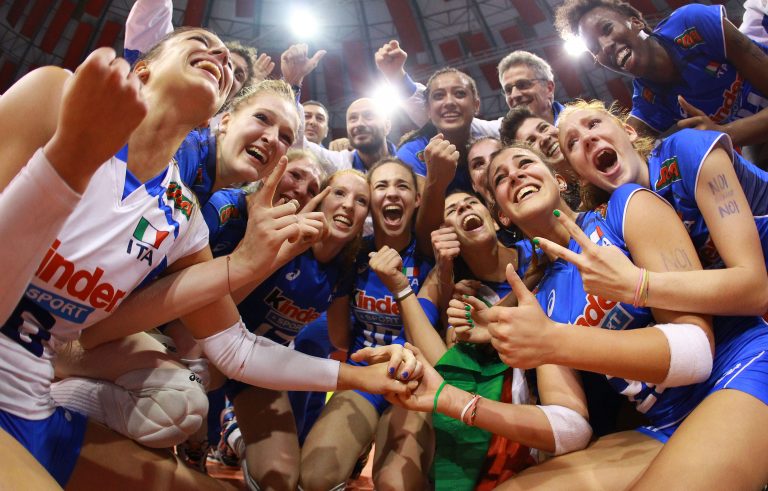
In what was described as a ground-breaking meeting, the FIVB Board of Administration set out the path for a “new era in world volleyball.”

Said President Dr. Ary S. Graça F: “Our vision for the FIVB in 2024 is clear and ambitious. It will not be possible to reach our vision if we talk for seven years and only act in the last year,” said the President. “The changes we are making will take time to show good results. So, it is important to make them as early as possible.”

A key first step in achieving this vision is for the FIVB to regain full control of its media rights and to concentrate activities around content production and distribution, in conjunction with the confederations and national federations. With the focus primarily on top level events (such as the World Championships and the group one matches of the World League and World Grand Prix), volleyball fans can expect to consume compelling content, across a diverse number of digital platforms, all year round.

The Board of Administration also approved a series of procedural checks and balances, to ensure a higher level of transparency and financial control over the FIVB’s projects and investments. By holding itself to even greater standards of good governance, the FIVB has taken a critical step forward on the road to financial stability and long-term growth and development of the sport.

Recognizing the need for a more fluid approach to decision making, the Board instituted some significant changes to the FIVB’s working structures and practices. Of note is the number of current and former coaches and players who are now part of the governing body’s Commissions.

They include the legendary Karch Kiraly, the only player to have won Olympic gold medals in both volleyball and beach volleyball and China’s volleyball icon, Lang Ping who made history at Rio 2016 for winning gold as player and coach. Joining them on the technical and coaching commission is current coach of Brazil’s women’s team, José Roberto ‘Ze Roberto’ Guimaraes, who has led his country to three Olympic gold medals and Italian Giovanni Guidetti, who has taken the Dutch women’s volleyball team to a silver medal in the 2015 European Championships.

The wealth of experience they bring to the table and the inclusion of ‘voices from the ground’ will go a long way in ensuring that choices made at the international level are relevant and make an impact on the sport. Likewise, volleyball stars like Brazil’s Giba and 2013 Beach Volleyball World Champion Xue Chen – who have already been informing the work of the FIVB since the Athletes’ Commission was set up in August – have played an important role in putting athletes’ voices at the heart of decisions made at the FIVB. – “With four more years to go until the next Olympics, the dynamic, new FIVB Board of Administration meeting has put the organisation on the right track to making volleyball the ‘number one family sport entertainment in the world’,” concludes a FIVB press release.

This story first appeared in the blog, The Sport Intern. The editor is Karl-Heinz Huba of Lorsch, Germany. He can be reached at [email protected]. The article is reprinted here with permission of Huba. 

IOC, NBCUniversal and USOC Announce Olympic Channel Partnership in the United States

0
IOC, NBCUniversal and USOC Announce Olympic Channel Partnership in the United States
American gymnastics stars Simone Biles, left, and Aly Raisman celebrate during the Rio 2016 Olympics gymnastics competition. Photo: By Danilo Borges via Wikimedia Commons

The International Olympic Committee (IOC), United States Olympic Committee (USOC) and NBCUniversal (NBCU) have today announced the creation of an Olympic Channel content and distribution partnership in the US.

During the second half of 2017, the partnership will launch a new US television network under the Olympic Channel: Home of Team USA brand that will offer fans year-round Olympic-sport programming from across the globe, with an emphasis on American athletes and teams.

The new partnership complements the Olympic Channel, which launched as a worldwide digital platform following the Closing Ceremony of the 2016 Olympic Games in Rio de Janeiro.

Along with the Channel, the partnership also brings additional coverage of Olympic sports programs that will appear exclusively on other NBCU platforms – including NBC, NBCSN and NBC Sports Digital outlets.

The first such coverage begins on Saturday (December 17), with the Team USA Winter Champions Series.

“The launch of the Olympic Channel: Home of Team USA partnership marks an exciting opportunity to promote and celebrate Olympic and Paralympic sport year-round,” said Scott Blackmun, chief executive of the USOC.

“Additionally, launching in conjunction with the inaugural Team USA Winter Champions Series broadcast is a great way to serve the fastest-growing fan base in American sports.”

The USOC proposed launching its own version of an Olympic channel around 10 years ago, but chairman Larry Probst said that plans had to be shelved so as not to harm Chicago’s bid for the 2016 Olympic Games.

The body had intended starting its project in 2010, with American global telecommunications conglomerate Comcast Corporation agreeing to carry the channel in its cable line-up.

However, when it emerged that the USOC were looking to create their own Olympic Network channel, the IOC and then President Jacques Rogge were so outraged that it was claimed Chicago’s 2016 bid would hugely suffer as a result.

As it turned out, Chicago were eliminated in the first round of elections at the IOC Session in Denmark’s capital Copenhagen in October 2009 after receiving just 18 votes.

Rio de Janeiro was eventually named host by Rogge after beating Madrid in the final run-off by 66 votes to 32.

The IOC, USOC and NBCU will collaborate to produce and distribute Olympic sports and Olympic-themed programming on a year-round basis between the Games.

The programming will include live events from a broad portfolio of Summer and Winter Olympic sports.

It will also feature Olympic-themed original content produced by all three parties, such as original programs produced by filmmakers from around the world commissioned by the global Olympic Channel, archival footage from the IOC and NBCU’s library of Olympic features and documentaries and original Team USA programming contributed by the USOC.

Commenting on the partnership, Olympic Channel general manager Mark Parkman said: “We’re very excited about this news.

“We launched the Olympic Channel at the Closing Ceremony in Rio, and we’ve always said that the Olympic Channel is an evolutionary product.

“This exciting news is an extension of that platform on TV produced for a US audience.

“It was a step that we know was worth pursuing for the growth of the Olympic Movement and what we want to attain through the Olympic Channel and this endeavour that we’ve embarked upon.

“With our partnership with NBC and the USOC on this, we believe that this will help the Olympic Movement substantially in one of our key markets.”

Gary Zenkel, President, NBC Olympics, added: “It’s an exciting day for NBC and the Olympic Movement in the US.

“It’s a continuation and validation of the strength of our long-term partnership and commitment to this incredible franchise that we at NBC are honored to help steward here in the US.

“We’ve done it for decades and we, of course, are signed up into the future.”

The US Ski and Snowboard Association (USSA) have spoken of their support for today’s announcement.

“The Olympic Channel launch is yet another opportunity to provide more value to our fans by connecting them with a new media outlet to showcase our athletes who are striving to be best in the world in Olympic skiing and snowboarding,” the body said in a statement.

“We applaud NBCUniversal’s continued commitment to expanding the reach of ski and snowboard programming, and the partnership with both USOC and IOC.”

The Olympic Channel was launched on August 21 as a key part of the Olympic Movement’s push to engage more young people and spark interest in Olympism all year-round.

IOC members unanimously approved the Channel – which has a fully-funded budget of $490 million for its first seven years – at the 127th IOC Session in Monte Carlo.

By Daniel Etchells

Republished with permission from insidethegames.biz

ESPN For Sale? Doesn’t Seem Likely

0
ESPN For Sale? Doesn’t Seem Likely
Photo: AP Photo/Claudio Cruz

The woes of Disney and ESPN have caught the attention of one money analyst who has suggested Disney should unload the 80 percent share of ESPN it owns. That prompted a day long discussion on Comcast’s CNBC from analysts, some of whom missed the 2008 financial meltdown but are still inexplicably employed by Comcast/CNBC to explain economics, of what the Disney should do with ESPN.

In February 2004, Comcast’s CEO Brian Roberts made a $66 billion offer to take over Disney but the Disney board refused to play ball with the Philadelphia-based cable CEO. By 2004, Comcast had become the United States biggest cable TV multiple systems operator. Roberts went after the ABC TV network along with the Disney film studio, ESPN and other Disney-owned cable TV networks, the various ABC radio networks and theme parks. At the time, Roberts had a rather weak cable TV sports network, the Outdoor Life Network and a number of other cable entities including E! Entertainment Television, the Golf Channel and ownership in the National Basketball Association’s Philadelphia 76ers and the National Hockey League’s Philadelphia Flyers. Disney rejected Roberts’s overtures.

In 2009, Roberts went after and got NBC Universal but there is a difference between Comcast and Disney. Disney is just a content provider while Comcast is one of the owners of the information highway.

Disney has shown no inclination that it wants to sell ESPN or spin it off into another company. There have to be concerns throughout the cable/satellite industry that people are cutting the cord and living without cable and are opting for different video delivery systems. The cable news networks are losing subscribers too but the difference is this, ESPN, NBC Sports, FOX sports is paying a premium price for programming and passing it onto subscribers, the others are not as invested.

As of now, there are no for sale signs on ESPN’s Bristol, Connecticut lawn.

By Evan Weiner For The Politics Of Sports Business

This article was republished with permission from the original publisher, Evan Weiner.

Rowbottom: Why Nike’s New Marathon Project Could End Up Breaking More Than 2

0
Rowbottom: Why Nike’s New Marathon Project Could End Up Breaking More Than 2
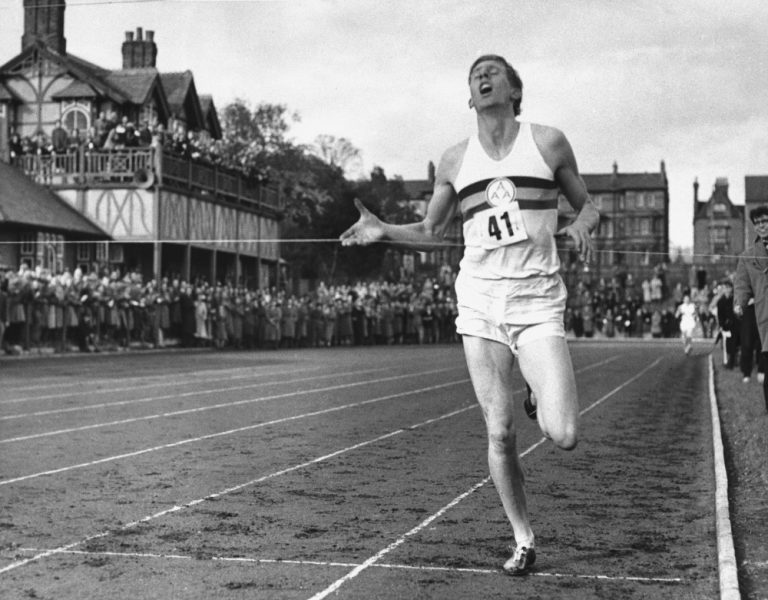
In this May 6, 1954, file photo, British Athlete Roger Bannister breaks the tape to become the first man ever to break the four minute barrier in the mile at Iffly Field in Oxford, England. Photo: AP Photo/File

The two-hour barrier for the marathon race has the same kind of mystique about it as did the four-minute mile before Roger Bannister became the first man to beat the latter landmark on a damp and inauspicious day in Oxford 62 years ago.

This week Nike, the US-based giant of sports shoe and apparel manufacturing, has launched an elaborate project – “Breaking2” – to propel one of three leading runners towards running the first sub two-hour marathon in 2017.

 “To help achieve this feat,” says the Q&A section attached to the press release announcing Nike’s latest pet project, “Nike is working with a diverse team bringing together world class expertise across several fields of science and sport.

“We are taking a holistic approach to athletes, product innovation, environment (so course and conditions), training, nutrition and hydration, to try reduce the existing fastest marathon time by at least 3 percent (1hr 59 mins, 59 secs).”

This latest initiative is described as a “moonshot attempt” at a sub two-hour marathon time. A curious image which brings to mind the US/Soviet race to become the first nation to plant its flag on the little ball of cheese I can see even now if I look out of my window.

Nike does indeed go on to ask itself if its effort is different from the Sub2HR project currently being championed by Professor Yannis Pitsiladis, the charismatic Professor of Sport and Exercise Science at the University of Brighton, who is raising funds to try and bring about a sub-two hour marathon by 2019. And has been criticized by many for shooting at the moon…

The company’s answer to itself is: “Breaking2 is an independent effort that Nike is leading to break the two-hour marathon. This is the holy grail of distance running, and we are excited at the possibility of empowering our athletes to achieve this incredible goal, with our expertise and product innovation. In any sport there are a number of players, and we have developed the approach that we’re confident in.”

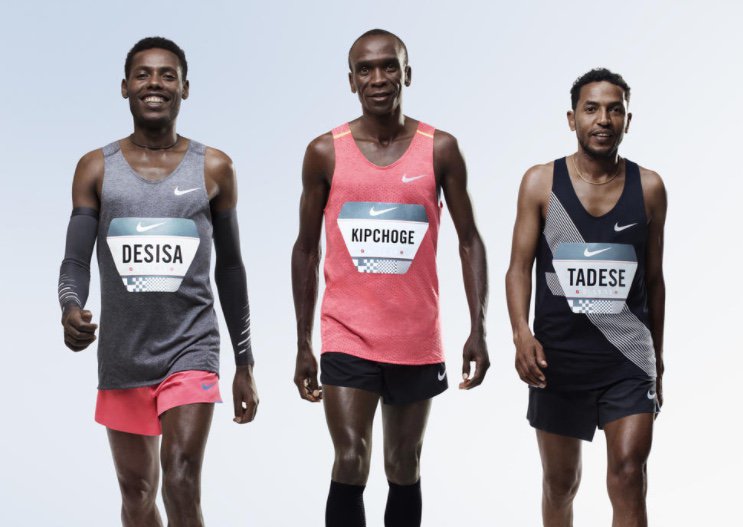
Lelisa Desisa, Eliud Kipchoge and Zerseney Tedese are all targeting a sub-2 hour marathon. Photo: Nike

The three athletes – Nike athletes, naturally – who have been chosen to benefit from this corporate brainstorm are Kenya’s Olympic champion Eliud Kipchoge, Eritrea’s five-times world half marathon champion and record holder Zersenay Tadese and Ethiopia’s Lelisa Desisa.

So far, so marketable. But while the overall aim of the exercise is clear enough from its title the detail is curiously opaque.

“We are not disclosing the exact timing or location at this stage,” says the Q&A section. “We can say that we are hopeful the attempt will take place in 2017 and that we will announce both the location and timing in due course.”

The three athletes will have to miss competing in any of the traditional spring marathons next year – “the athletes are stepping out of the marathon circuit to train and make this attempt.” This attempt will not take place at “a sanctioned marathon event.”

So what exactly, one wonders, are the top bods at Nike going to have this trio do? Run down one of the mountains of Oregon? (Although that would certainly work headline-wise – “Two hour barrier busted at Bunchgrass Butte”, or maybe “Marathon landmark landed at Three Fingered Jack”).

Or perhaps they are going to do something imaginative in zero gravity at the NASA Space Laboratory? On a historical sporting note, watching Apollo 14 astronaut Alan Shepard drive a golf ball for a mile or two in the reduced-gravity atmosphere of the moon has not prompted lesser earthlings to match his feat on terra firma.

Nike admits that whatever it has in mind to produce this landmark time will not be ratifiable by the International Association of Athletics Federations. “The attempt will be honest and fair, and what we learn will inform generations of runners…the actual attempt will not be an officially sanctioned world record. We believe it will show the potential to break it and enable future official times to fall.”

There is no doubt that there is something to this line of thought.

In the weeks before Bannister – referenced in the Nike promotional material – made his breakthrough his Australian rival John Landy ran three miles in 4min 2sec, commenting afterwards: “Two little seconds are not much, but when you’re on the track those 15 yards seem solid and impenetrable, like a cement wall.”

Ultimately the barrier was a mental rather than a physical one – and once the Oxford medical student had got his head around it his effort was surpassed swiftly and increasingly.

May 6, 1954 was Bannister’s day of days. He was world record holder for only a couple of months before Landy lowered the record from 3min 59.4sec to 3:58.00. And so it began. Hicham El Guerrouj of Morocco has held the current record of 3:43.13 since 1999.

As far as the marathon is concerned, Dennis Kimetto’s world record time, set at the 2014 Berlin Marathon, is 2hr 2min 57sec. And so it goes on…

But here’s the thing.

Personally I have always hated prepared Q&A sheets.

The problem I have with them is twofold. Firstly, if the same people are providing questions and answers you often end up with the kind of absurdity that crops up halfway through this earnest Nike effort:

Q: “How much is Nike investing in this?”

A: “We don’t provide financial information for projects like this.”

Secondly, the questions I would want to ask never seem to get asked, never mind answered.

So here is my question for Nike. Taking on board your repeated assurances that all this is not about Nike or marketing or anything remotely like that, what do you think it would do for, or do to, marathon running to have a lab rat run a sub-two hour time?

We don’t know the detail, of course. But it sounds as if the Breaking2 project, if successful, would simply ruin the sense of achievement when a runner finally passes the finish line inside two hours on a bona fide marathon course for a bona fide world record.

By Mike Rowbottom

Republished with permission from insidethegames.biz

Armour: Get Excited for the Participation Trophy Award Bowl

0
Armour: Get Excited for the Participation Trophy Award Bowl
Mississippi State quarterback Nick Fitzgerald led the Bulldogs to a 35-28 upset of Texas A&M on Saturday. The Bulldogs will play in the St. Pete Bowl on Dec. 26 against Miami (Ohio). Photo: Matt Bush/USA Today Sports

In the bad old days before the College Football Playoff, one of the loudest arguments against it was that it would kill the bowl system.

Oh, we should be that lucky.

The bowl season kicks off Saturday, and it won’t be long before we’re reminded of how bloated and out-of-control the system has become. The last game of the day is the Participation Trophy Award Bowl, featuring Louisiana-Lafayette and Southern Miss in a snooze-inducing clash of two 6-6 teams.

OK, so it’s really the New Orleans Bowl. But Participation Trophy Award is more appropriate given how the bowl system has run amok.

There are 41 bowls this year and 128 FBS teams. That means a whopping 62.5% of teams are getting the “honor” of playing in the postseason. Making it even more ridiculous, 20 of the games will have teams with 6-6 records – or worse.

My personal favorite is the St. Pete Bowl on Dec. 26, which features Miami (Ohio) with a 6-6 record and Mississippi State, one of two bowl teams with a 5-7 record. That’s a game even alumni can’t love.

There’s also the Miami Beach Bowl, which will be played in the middle of the afternoon on Monday, Dec. 19. Featuring one of those 6-6 teams, no less. If you’re wondering if that’s the bowl equivalent of a tree falling in the forest when no one is around to hear it, you are not alone.

Once upon a time, the bowl system actually meant something. With fewer games — there were just 18 only 20 years ago — each was significant, an event as much as a game. How many other sporting events could throw a parade and not only not look foolish, but have it become a time-honored tradition?

And winning a bowl like the Rose, the Cotton or even the Citrus Bowl gave a team a certain cachet.

The Rose Bowl has been played longer than Alaska and Hawaii have been states. The Cotton Bowl’s proud history includes Bear Bryant, the great Texas teams and Notre Dame’s return to the postseason after a 45-year absence.

But promoters and tourism officials got greedy, and now the market is flooded with cheap knockoffs like the Quick Lane, Pinstripe and Russell Athletic bowls — the last of which has also been known as the Carquest, Florida Tourism and MicronPC Bowl. Nothing says national powerhouse quite like champion of the Quick Lane Bowl.

As the number of games has increased, the value of all but a few of the signature bowls has diminished. Bowl officials will squawk at that, touting the economic boost to host cities and teams, along with the added exposure and practice time for the teams.

You can’t argue with the numbers, however. USA TODAY Sports reported this week that six bowls had not yet found lucrative title or presenting sponsors. One of those, that Miami Beach Bowl, has never had a title sponsor in its three-year history.

This on top of eight consecutive years of declines in average bowl attendance.

For years, ESPN has helped bankroll the bowl glut because it provides the network with programming fodder. ESPN will broadcast 28 bowls this years, along with the “New Year’s Six” and the playoff semifinals at the Peach and Fiesta bowls.

ESPN also has the College Football title game.

“The bowl system is incredibly healthy,” Clint Overby, vice president of ESPN Events, insisted.

He says that now. But as cord cutting continues and ESPN finds the financial landscape increasingly challenging, it’s easy to see how the Famous Idaho Potato Bowl or the Heart of Dallas Bowl could suddenly become expendable.

At least, let’s hope.

By paring back the number of lower-tier bowls, it will restore luster to the ones that really matter. You know, the ones that don’t have to fake enthusiasm as they invite a team with a .500 record.

Kids generally outgrow the participation awards by the time they’re in middle school. It’s time the bowl system did, too.

By Nancy Armour

This article was republished with permission from the original author and 2015 Ronald Reagan Media Award recipient, Nancy Armour, and the original publisher, USA Today. Follow columnist Nancy Armour on Twitter @nrarmour.

The 2016-17 Bowl Season Is Here

0
The 2016-17 Bowl Season Is Here
The Ohio State Buckeyes will face the Clemson Tigers in the College Football Playoff semifinal on 31 December in the PlayStation Fiesta Bowl. Photo: thepostgame.com

As the 2016-17 college football bowl season approaches the next three weeks will be filled with excitement all around the country. There will be six games kicking off the bowl season starting Saturday, 17 December, 2016. The first games kicks off at noon Eastern Standard Time with North Carolina Central vs. Grambling in the Celebration Bowl. Hardly a day will go by over the next three weeks without a bowl game being played every day or night on ESPN.

The two semifinal games will be played on 31 December, 2016 in Atlanta, Ga., and Glendale, Ariz., with the winners of those two games facing off for the National Title on 9 January, 2017 in Tampa, Fla. If you are a college football fan many would say this is their favorite time of the year. This time of the year many of the coaches know they have one game left and bring out the craziest pages in their playbooks.

Some will say it’s tough to get excited about the bowl season with the litany of games. As a youngster I looked forward to watching the best teams in college football play each other, but the bowls have become less indulging with teams playing that have losing records. There are now 42 bowl games on the slate. There are 128 Division I Football Bowl Subdivision (FBS) teams. With the number of bowl games available this means 82 teams, or 64% of the teams play in a bowl game.

I understand this means more practices and time to work with younger players, but is it watering down what it means to be selected for a bowl game? A team can be below average and make a post season bowl game. I don’t know if that’s good for college football. What I do know is the pageantry of bowl games like the Rose Bowl, Sugar Bowl, Cotton Bowl, Orange Bowl, and Fiesta Bowl can be second to none.

For the communities hosting these bowl games, the fans bring their wallets with them. These fans come out in full force to support their teams and spend money on food, shopping, attractions, and more. Whether it is a small town or a large city, bowl games generate spending, create, jobs, and provide a lasting impact on the host communities. The 42 bowls provide countless opportunities for fans, teams, and communities alike to come together. Enjoy the bowl games and may the best teams win!

By Dr. Bret Simmermacher

Dr. Simmermacher is the Chair of Sports Coaching at the United States Sports Academy, and can be reached at [email protected]

USA Swimming Executive Director Chuck Wielgus Earns 2016 Honorary Doctorate from the United States Sports Academy

0
USA Swimming Executive Director Chuck Wielgus Earns 2016 Honorary Doctorate from the United States Sports Academy
Charles “Chuck” Wielgus, Executive Director of USA Swimming, center, recently was presented the 2016 National Honorary Doctorate degree from the United States Sports Academy for his lifetime of service to the world of sport. The presentation was made at the USA Swimming headquarters in Colorado Springs, Colo., by William Hybl, President Emeritus of the United States Olympic Committee and Chairman and Chief Executive Officer of El Pomar Foundation, left, and Walter Glover, Executive Vice President of the U.S. Olympic Endowment.

Charles “Chuck” Wielgus, executive director of USA Swimming, has earned a 2016 Honorary Doctorate from the United States Sports Academy for his lifetime of service to the world of sport.

Each year as part of its Awards of Sport program, the United States Sports Academy presents two honorary doctorates – one national and one international. Recipients are presented with a hood, citation, plaque and transcript signifying their honorary degree.

Wielgus is widely credited for making swimming the most successful of Team USA’s Summer Olympic sports, having served as the executive director of USA Swimming since 1997 and as chief executive officer of the USA Swimming Foundation since its inception in 2004.

During his tenure, Wielgus has led USA Swimming through an extended period of growth in what has become an increasingly competitive marketplace. Membership in USA Swimming has surpassed 400,000, while organizational revenues and net worth have more than quadrupled under his direction.

Under Wielgus, the United States Olympic Swim Team has won an average of 31 medals in each of the last five Olympic Games to lead all of Team USA’s medal counts. In the recent 2016 Olympic Games in Rio de Janeiro, U.S. swimmers collected 33 total medals, including 16 gold first place finishes.

Wielgus is also credited with repositioning the U.S. Olympic Trials-Swimming into a major showcase event by moving the competition from a 4,700-seat natatorium to an entertainment venue with 15,000 seats. The 2016 Olympic Trials sold more than 200,000 tickets for 15 sessions at the CenturyLink Center in Nebraska.

Additionally Wielgus has made strides in introducing American children to the sport of swimming by spearheading the creation of the USA Swimming Foundation and its Make a Splash initiative, which aspires to teach every child in America how to swim. Financial support to USA Swimming National Team athletes and coaches has also increased significantly under his leadership.

Wielgus has dedicated most of his professional life to sport. Prior to his work at USA Swimming, the Larchmont, N.Y., native was the executive director of the Senior PGA Tour Tournament Directors Association. At the time he also served on planning committees for the World Golf Village and International Golf Hall of Fame. From 1989-96 he was the executive director of the United States Canoe and Kayak Team, the national governing body for that Olympic sport.

From 1983-89 Wielgus was the executive director of the Hilton Head Island Recreation Association, where he led the effort to produce the master plan for the resort island’s public recreation facilities and sports programs. From 1974-83 he was a coach and recreation director in Woodstock, Vt., where he coached basketball, lacrosse and swimming and served two terms as the president of the Vermont Recreation and Parks Association.

Wielgus earned his bachelor’s degree in history from Providence (Rhode Island) College in 1972 and his master of education degree from Springfield (Mass.) College in 1974.

He was recognized as a Sports Ethics Fellow in 1996 by the Institute for International Sport at the University of Rhode Island in Kingston, R.I., and has received awards from the American Swimming Coaches Association, College Swimming Coaches Association, International Swimming Hall of Fame, El Pomar Foundation and was the 2011 recipient of the National Great Comebacks Award for his cancer survival and contributions. He was also awarded the first-ever Association of Chief Executives of Sport (ACES) Chief Executive Leadership Award in 2015.

He has co-authored three books with Sports Illustrated writer Alexander Wolff and was the executive co-producer for the recent documentary film, “The Last Gold,” which tells the story of the 1976 Montreal Olympic Games.  He resides in Colorado Springs with his wife Nancy Grace Wielgus. He has four children.

The Honorary Doctorate program is part of the United States Sports Academy’s Awards of Sport, which each year serve as “A Tribute to the Artist and the Athlete.” The Academy presents the awards to pay tribute to those who have made significant contributions to sport, in categories as diverse as the artist and the athlete in several different arenas of sport. The awards honor exemplary achievement in coaching, all-around athletic performance, courage, humanitarian activity, fitness, and media, among others. The Academy’s American Sport Art Museum and Archives (ASAMA) annually recognizes these men and women through its Sport Artist of the Year, Honorary Doctorates, Distinguished Service Awards, Medallion Series, Outstanding Athletes, and Alumni of the Year awards.

Based in Daphne, Ala., the United States Sports Academy is an independent, non-profit, accredited, special mission Sports University created to serve the nation and world with programs in instruction, research, and service. The role of the Academy is to prepare men and women for careers in the profession of sports. For more information about the Academy, call (251) 626-3303 or visit www.ussa.edu.

Founded in 1984, ASAMA is dedicated to the preservation of sports art, history, and literature. The ASAMA collection is composed of nearly 2,000 works of sport art across a variety of media, including paintings, sculptures, assemblages, prints and photographs. The museum is open free to the public from 9 a.m. to 5 p.m. weekdays. For more information, go to www.asama.org.

By Eric Mann

Eric Mann is the communications assistant at the United States Sports Academy. Reach him at [email protected]