Home Blog Page 357

Los Angeles 2024 Officials Predict Good Relationship with ‘Enthusiastic Olympic Supporter’ Trump

0
Los Angeles 2024 Officials Predict Good Relationship with ‘Enthusiastic Olympic Supporter’ Trump
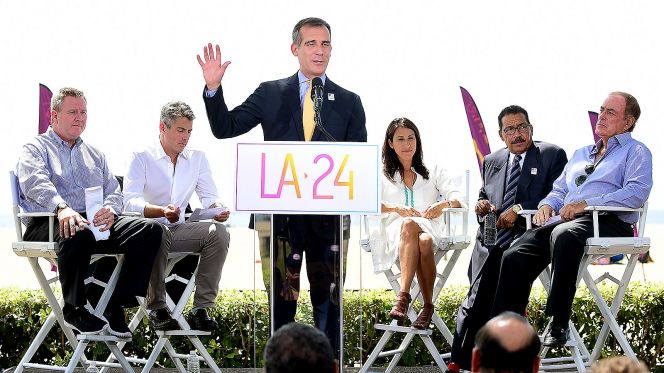
Photo: FREDERIC J. BROWN, Fox Sports

Los Angeles 2024 leaders expect United States President-elect Donald Trump to be an “enthusiastic supporter” of their Olympic and Paralympic Games bid and have already begun attempts to build a relationship with his administration.

Speaking ahead of the Association of National Olympic Committees (ANOC) General Assembly, the bid leaders sought to distance themselves from speculation that last week’s shock victory for Trump over Hillary Clinton was a blow for the bid.

They also claim his win was “part of a global pattern” being replicated elsewhere.

“Donald Trump is an enthusiastic supporter of sport,” Gene Sykes, chief executive of Los Angeles 2024, told insidethegames here.

“He is also an Olympic fan.

“Expect him to be a supporter of ours and to be enthusiastic about the Olympics.”

Los Angeles 2024 chairman Casey Wassermann did not go as far as to praise Trump but claimed that the Olympic bid is separate from the political process and that “local support” in California will be key.

“A bid is not about politics,” Wassermann told insidethegames.

“It is about bringing the city together.”

Los Angeles Mayor Eric Garcetti – leader of his city’s delegation here this week – had claimed the same during the Olympic Games in Rio de Janeiro.

He said then that “an America that turns inward, like any country that turns inward, isn’t good for world peace, isn’t good for progress, isn’t good for all of us”, and that “some of the International Olympic Committee (IOC) members they would say, ‘Wait a second, can we go to a country like that, where we’ve heard things that we take offence to?'”

Both Garcetti and Wassermann are associated with the Democrat Party but Goldman Sachs banker Sykes is, like Trump, a Republican.

They claim to have already begun building relationships with those close to Trump.

But they consider it “too early to call,” however, over the question of whether he will attend the IOC Session in Lima on September 13 next year where a decision will be made between Los Angeles and European rivals Budapest and Paris.

Rome “suspended” itself from the process last month after failing to get support from the Italian capital’s Mayor Virginia Raggi.

“We’re focused on the job ahead with 10 months to go,” said Wassermann.

Few IOC members seem to think that Trump’s victory will impact Los Angeles 2024 in a negative way.

Sykes claims that some have remarked to him that Trump’s victory is part of a “worldwide process” also being replicated elsewhere.

Elections to choose a new President in France are due to take place next April and May.

A leading candidate is expected to be French National Front leader Marine Le Pen.

Hungary are currently led by Prime Minister Viktor Orbán, a right-wing conservative who has received criticism outside the country for his strong attitude against migrants.

By Nick Butler

Republished with permission from insidethegames.biz

Why the Raiders Should Leave Oakland (And Others Should Do The Same)

0
Why the Raiders Should Leave Oakland (And Others Should Do The Same)
Oakland Coliseum, home to the Oakland Athletics and Oakland Raiders. Photo: chatsports.com

Roughly five years ago, I decided I wanted to work in law enforcement. I went to my family and laid out my plan. The anti-cop attitude in the country and media was just beginning to climb to the summit of what we have been seeing today. I went to my father and told him what I wanted to do. He told me that he was supportive of what I wanted to do, with one exception. He made me promise him that I would never work in Oakland. “You’ll get shot!” he proclaimed.

Growing up in Northern California, Oakland was almost a taboo place. I was given the impression at a young age that if you go to Oakland you only leave in a body bag. The FBI agrees. In 2013, the FBI released its annual crime statistics report. Oakland was ranked the 2nd most dangerous city in the United States of America. Detroit, Michigan was the only city more violent. According to the crime report, just under 20 out of every 1,000 people were the victims of violent crime in Oakland in 2013. This report is not an anomaly, the previous year in 2012, the Oakland Homicide count was an astounding 127. According to cityrating.com Oakland’s violent crime rating was a whopping 415.23% higher than the entire national average.

Cityrating.com also laid out specific crime statistics for 2012. Oakland suffered 3,227 reported aggravated assaults, 271 forcible rapes, 6,976 automobile thefts and 26,530 property crimes. 2016 isn’t shaping up any better. Oakland is currently on pace for 3,635 assaults, 278 rapes, 6,078 auto thefts and just over 21,000 property crimes with 118 homicides to boot.

Where does this leave the major sports teams currently residing in Oakland? The Raiders, Warriors and Athletics all have called Oakland home for many years.

The Warriors already have plans to move back across the Bay Bridge to San Francisco into a privately financed stadium in 2017. The Raiders have played at the Oakland Coliseum since 1995. The building is a dilapidated piece of junk. The Raiders share Oakland Coliseum with the Oakland A’s. Since the baseball season and football season overlap, the Raiders are forced to play their first-half NFL home games on a baseball diamond like a JV high school team.

The Raiders have already secured a nice spot in the Las Vegas desert. The Nevada Legislature voted in October to create a room tax on Clark County hotel rooms to finance half of the new stadium. The Raiders relocation must be approved by three- fourths vote by NFL owners.

Recent reports from the NFL suggest rumors that the league wishes to keep the Raiders in Oakland, due to the large market in the Bay Area. This is mind boggling, considering the league is hellbent on creating a family-friendly atmosphere. The NFL and every other sports team in Oakland should cut ties with the city and move elsewhere. The Athletics were 29th in average attendance in 2016. A move north to Sacramento could spike attendance through the roof.

Sporting events are great family outings. The well-earned reputation of Oakland diminishes the family aspect. I am not insinuating that Las Vegas is a crime-free sanctuary, because it is not. I am saying that I would take my Family to one hundred Las Vegas Raiders games before I took them to a single Oakland Raiders game. I believe the Raiders, Warriors and A’s would see a surge in fan base if they abandoned Oakland once and for all.

By Kyle Jones

Kyle Jones is a husband, rabid sports fan, law enforcement officer and an amateur sports writer. Any inquiries can be sent to [email protected].

Monahan to Replace Finchem as PGA Tour Commissioner

0
Monahan to Replace Finchem as PGA Tour Commissioner
Jay Monahan has been appointed commissioner of the PGA Tour following Tim Finchem's retirement. Photo: Skysports.com

The Professional Golf Association (PGA) Tour Policy Board has announced the appointment of Jay Monahan as their next commissioner, following the retirement of Tim Finchem.

Monahan, who is the currently the Tour’s deputy commissioner and chief operating officer, will assume office from January 1, 2017.

The move was unanimously approved during the Policy Board’s meeting at PGA Tour headquarters in Ponte Vedra Beach in Florida.

Finchem is stepping down after serving more than 22 years as the Tour’s third commissioner, after he began his tenure in 1994.

“Jay has proven himself to be an outstanding leader who has developed an intimate knowledge and understanding of the PGA Tour and a clear vision for the future of the organisation,” said Victor F. Ganzi, chairman of the Policy Board.

“He is highly respected among our members, staff, business partners and the golf industry as a whole.

“We are extremely fortunate to have someone of Jay’s caliber fully prepared to assume the role of Commissioner and lead the PGA Tour’s exceptional executive team as it continues to build upon the remarkable success achieved under Tim’s leadership.”

Monahan follows a similar path to the position that his predecessor did, who also served as the Tour’s deputy commissioner and chief operating officer before being named Commissioner.

“I am greatly honored by the trust the Policy Board has shown in me to succeed Tim Finchem as commissioner,” Monahan said.

“Under Tim’s leadership, the PGA Tour has made remarkable progress, even in the most difficult economic times.

“We are now entering a very important time in our organisation’s history, and I know our executive team and I will draw upon and be inspired by the invaluable experience of working with Tim.”

During Finchem’s term the PGA Tour has “continued its tremendous growth, from record purses, revenue and charitable contributions”, it is claimed.

Finchem’s tenure has also included the creation of internationally renowned tournaments such as the FedExCup and Presidents Cup.

By Max Winters

Republished with permission from insidethegames.biz

Russian Athletes Found Guilty of Tainting Doping Samples Could Face Three Years in Jail

0
Russian Athletes Found Guilty of Tainting Doping Samples Could Face Three Years in Jail
A Rio 2016 Olympic Games drug testing lab. Photo: Rio2016.com

Athletes and officials found guilty of manipulating samples could be jailed for up to three years as part of a proposal from Russia’s State Duma aimed at combating the country’s doping problem.

Dmitry Svishchyov, a member of the Duma Committee for Physical Culture and Sports, told Russia’s official news agency TASS that the bill would be submitted for discussion in the near future.

It comes amid continued attempts from Russia to criminalize doping.

Svishchyov warned, however, that the sanctions for the tainting of anti-doping samples included in the proposal are likely to be reduced to imprisonment of just one year.

This was the case with the recent anti-doping bill in Russia, passed earlier this month, where prison terms for coaches found guilty of coercing athletes into taking performance enhancing drugs were introduced.

Those found responsible for athletes taking outlawed substances, regardless of their consent, could face a fine of one million roubles under the bill.

A two year “restriction of freedom” or a one-year prison sentence could also be issued.

Svishchyov said he had originally asked for a jail sentence of three-years but admitted this had been changed by the Government, as had been suggested.

“The Government sent amendments to the bill ‘for encouragement into doping’ where it recommended that the term be cut to one year,” he told TASS.

“I believe that the same will be in this case and our proposal will be amended.

“If we have introduced criminal liability for encouragement and coercion [into doping], then the same punishment should be introduced for falsification with [doping] samples.

“This will stop and sober up athletes and show that falsification is not worth doing for athletes to become medal holders for a while.

“If athletes themselves are involved in the falsification of samples, this law will be applicable to them as well.”

The latest motion from the State Duma comes ahead of the publication of the second part of the McLaren Report next month.

Russia, currently still suspended by the International Association of Athletics Federations and the International Paralympic Committee, are accused of illegally swapping tainted urine samples for fake ones at events including their home Sochi 2014 Winter Olympic and Paralympic Games.

It is alleged that more than 15 medal winners are implicated.

As a result of the report, Russia’s team for the Olympic Games in Rio de Janeiro was significantly reduced, while the entire nation was banned from the Paralympics the following month.

An anti-doping Commission headed by honorary International Olympic Committee member Vitaly Smirnov has also been set-up to investigate wrongdoing.

By Liam Morgan

Republished with permission from insidethegames.biz

Bolt, Farah and Van Niekerk Shortlisted for Men’s World Athlete of the Year Prize

0
Bolt, Farah and Van Niekerk Shortlisted for Men’s World Athlete of the Year Prize
Usain Bolt. Photo: Flickr/doctorcliff

Jamaican sprint legend Usain Bolt, Britain’s distance running superstar Mo Farah and South Africa’s Rio 2016 hero Wayde van Niekerk have been announced as the three finalists for the 2016 International Association of Athletics Federations (IAAF) Male World Athlete of the Year award.

Bolt is chasing a record sixth male crown after completing the “triple triple” of 100, 200 and 4×100 meter relay titles for a third successive Olympic Games at Rio 2016 in August.

Farah will be seeking a first World Athlete of the Year crown to add to the European honor he received last month after a successful defense of his 5,000 and 10,000m Olympic titles in Rio de Janeiro.

Van Niekerk provided one of the moments of the Olympics when he produced a stunning world record time of 43.03sec to win 400m gold from lane eight, beating American Michael Johnson’s previous mark.

Ten athletes were shortlisted for the prize last month with that list now whittled down to the star-studded trio.

The women’s award will be contested by Ethiopia’s Olympic 10,000m champion Almaz Ayana, Jamaican Elaine Thompson, who won the 100 and 200m sprint double in Rio, and Poland’s hammer champion Anita Wlodarczyk.

Ayana also won 5,000m bronze in Rio, the distance she captured the world title over in Beijing last year.

Thompson, a 4x100m world champion in the Chinese capital, also won an Olympic silver medal in the team race in Rio.

Wlodarczyk broke the world record twice this year, including when winning in Rio with a throw of 82.29m.

She improved that to 82.98m on August 29 at the Kamila Skolimowska Memorial competition in Warsaw.

The two winners will now be announced live on stage at the IAAF Awards Night in Monte Carlo on December 2.

The six finalists were determined by a three-way voting process, with the IAAF Council’s vote counting for 50 percent of the result.

A further 25 per cent of the vote was determined by the “IAAF Family” – a group including press, partners and member federations – while fans made up the remainder.

American decathlete Ashton Eaton won the men’s prize last year, with Ethiopia’s middle and long distance runner Genzebe Dibaba scooping the women’s honor.

By Dan Palmer

Republished with permission from insidethegames.biz

Putin Orders Anti-Doping Improvements to be Made in Russia

0
Putin Orders Anti-Doping Improvements to be Made in Russia
Russian President Vladimir Putin. Photo: World Economic Forum Photo by Remy Steinegger.

Russian President Vladimir Putin has reportedly ordered a national anti-doping laboratory to be established at Moscow State University as the country seeks to tighten their anti-doping laws.

According to the Kremlin, the Russian President has instructed the Government to set up the laboratory, which would be part of the university’s science and education center.

Direct funding for the Russian Anti-Doping Agency (RUSADA) and possible amends of its current legislation are due to be assessed, along with the implementation of the country’s commitment to provide funding to the World Anti-Doping Agency (WADA) from their budget.

The State Duma were recommended to discuss and adopt a federal law to withdraw the sporting organisations from the list of the founders of RUSADA.

The Kremlin also revealed that the Ministry of Sport had been instructed to “draft and approve educational anti-doping programs for various types of educational and sports organizations.”

It was also recommended to the Russian Olympic and Paralympic Committees that their athletes are tested by RUSADA when they become a candidate to represent their international team for the first time.

Instructions to tighten anti-doping controls in the country come after several leading Russian athletes were banned from the Olympic Games in Rio de Janeiro.

Russia’s team was cut from its original number of 389 to 271 after the International Olympic Committee (IOC) Executive Board opted to defer the extent of Russian participation to the International Federations.

This followed the publication of the McLaren Report, which alleged a state-sponsored doping scheme within Russian sport.

An earlier report commissioned by the World Anti-Doping Agency and published in November 2015 had led to the International Association of Athletics Federations suspending Russia from international competition.

A total of 67 track and field athletes were prohibited from competing, with long jumper Darya Klishina their only athletics representative after she was able to demonstrate that she had operated outside the Russian system and had been subject to drugs testing by independent organisations.

The International Paralympic Committee introduced a blanket ban for Russia in the wake of the report.

Several appeals to get the ban overturned, including to the Court of Arbitration for Sport and the Swiss Federal Court, failed.

The second part of Richard McLaren’s report investigating accusations of state-sponsored doping in Russia is due to be published in mid-December.

It is expected to provide further evidence of an alleged Government-backed scheme in Russia, which was said to include their home 2014 Winter Olympics and Paralympics in Sochi.

By Michael Pavitt

Republished with permission from insidethegames.biz

Coach Orgeron and LSU in November

0
Coach Orgeron and LSU in November
Oct 1, 2016; Baton Rouge, LA, USA; LSU Tigers interim head coach Ed Orgeron before a game against the Missouri Tigers at Tiger Stadium. Mandatory Credit: Derick E. Hingle-USA TODAY Sports

On September 24 LSU lost to Auburn in a thrilling football game. If you will remember, LSU scored what would have been a game winning touchdown as time expired. However, after reviewing the play it was determined that LSU did not start the play before time expired and the touchdown was waived off. That allowed Auburn to win the game 18-13, leaving each team with a 2-2 record. The next day LSU fired long time coach Les Miles and named Ed Orgeron interim head coach for the next two months.

Coach Orgeron has made it very clear that he wants the job on a permanent basis. To win the job he has to win games. He did that during the month of October. LSU played three games and beat Missouri, Southern Miss and Ole Miss, games he had to win because he was supposed to win those games. All three games were home games. Missouri is the worst team in the SEC, Southern Miss from C-USA was “built in“ win, and Ole Miss is in last place in the SEC West. Arguably, LSU would have won all of those games with or without Les Miles. The tougher part of the schedule is in November.

LSU started November with a loss to Alabama with a final score of 10-0. A win against Alabama would have certainly been a defining win for Coach Orgeron, but it was not a must win. LSU played well against the top ranked team in the country and displayed all the characteristics of good team. They had a well-organized plan of attack, they played with effort, and they gave themselves a chance to win. Alabama is having a zenith year, and simply playing well in that game is good enough for Coach Orgeron.

However, LSU’s three remaining games against Arkansas, Florida, and Texas A&M are games where Coach Orgeron must demonstrate himself as a capable coach. LSU lives in a dangerous neighborhood, the SEC West. With 2 of the 3 remaining games against West opponents and both of them on the road, and a home game against Florida squeezed in between those games. The November part of the schedule is more indicative of what it is like to coach in the SEC. To be a contender in the SEC you have to find a way to play well and win when you have multiple tough games in consecutive weeks. It is an opportunity to define yourself as one of the best in the nation.

There is very little doubt that Coach Orgeron can recruit and connect to the LSU fan base. However over the course of the next three weeks, he needs to show to the LSU administration that he can successfully prepare a team week in and week out, that his team can put some points on the board, and that he can sustain success over time as a member of the SEC West.  If Coach Orgeron wants to be the next head coach at LSU he has to win big in November.

By Chris Coker

Chris Coker is the Director of Continuing Education at the United States Sports Academy. He can be reached at [email protected]

Nightengale: MLB’s Uncertain, Aggressive Winter

0
Nightengale: MLB’s Uncertain, Aggressive Winter
Major League Baseball commissioner Rob Manfred. Photo: http://theledgesports.com/

When baseball’s general managers’ meetings ended Thursday, no team could have imagined that the Atlanta Braves would out-spend everyone else, but then again, they weren’t envisioning Donald Trump to be their next president, either.

“It’s been an interesting couple of weeks,’’ Commissioner Rob Manfred said, smiling. “Cubs won the World Series for the first time in 108 years. Donald Trump got elected president. Pretty interesting all the way around.

“So here we are.”

While the Detroit Tigers and Chicago White Sox were the most popular teams at these meetings after declaring they’re open to trading away any of their star-studded players, politics dominated the conversation behind the scenes.

One general manager declared it the worst day in American history. Another executive jokingly told his assistant to find as many good players in Mexico as possible “before Trump builds that wall.’’ And another spent time comforting his distraught wife and crying daughter.

Baseball, too, faces an uncertain winter, a point driven home in three days of meetings.

“We sure got real popular here,’’ Tigers GM Al Avila said while heading back to Detroit. “It used to be that we’d be meeting with all of the agents. This time, we’ve been meeting with all of the teams.

“We have so many valuable pieces. We don’t know who’s going to stay or who’s going to go. We don’t know what direction yet we’re going to take.

“We’ll sit back and assess. It’s not going to be a tear-down, but an adjustment.’’

While the Braves out-spent everyone at these meetings – signing free-agent starter R.A. Dickey to a one-year, $8 million contract Thursday after re-signing pitcher Josh Collmenter to a one-year, $1.2 million deal – the most titillating action this winter will involve the trade market.

“Listen, there are good players out there,’’ Chicago Cubs GM Jed Hoyer said, “but this is probably the weakest free-agent class that we have seen, and probably will see for a while.’’

Indeed, unless you’re going to drop at least $100 million for sluggers Yoenis Cespedes or Edwin Encarnacion, or spend at least $75 million for closers Aroldis Chapman or Kenley Jansen, you’ve got no choice but to hit the trade market for help.

This is why the Tigers and White Sox can provide a virtual All-Star team with everyone they’re offering:

Starting pitchers: Chris Sale, Justin Verlander, Jose Quintana.

Closers: David Robertson and Francisco Rodriguez.

Infield: Miguel Cabrera, Ian Kinsler, Todd Frazier.

Outfield: J.D. Martinez, Justin Upton, Melky Cabrera and Adam Eaton.

DH: Victor Martinez.

The Houston Astros, hoping to become the American League’s version of the Cubs’ success story, have plans to dive right in.

“We’re ready to move quickly this year,’’ Astros GM Jeff Luhnow told USA TODAY Sports. “We don’t feel like we have to wait and see how the market develops, and try to pick up guys who make sense for our budget and our team.

“We’re prepared to start making some offers and being aggressive. If there’s a move that makes sense for our club right now, we’re going to do it. There’s a lot of moving pieces. I’d like to make one big move before the winter meetings, at least one. This will be a more interesting off-season for us than prior off-seasons.’’

Really, there’s a sense of aggressiveness throughout the industry. The only potential hold-up may be the collective bargaining agreement, with teams still not knowing the new draft compensation rules for free agents, or whether the $189 million luxury tax will significantly rise or stay flat.

“The CBA probably creates more uncertainty in these discussions,’’ Hoyer says, “because you don’t know what rules we’re playing by going forward. So that could slow things up. It adds some uncertainty to the process.’’

The Boston Red Sox, for instance, want to find a DH to replace retiring David Ortiz, and bullpen help. Yet, with a $200 million payroll and not knowing the tax ramifications, they may have no choice but to delve into the relief market first. They may have to wait before knowing whether they go for a shorter-term deal with Carlos Beltran, or a long-term plan with Encarnacion or perhaps Jose Bautista.

“There might have to be some patience involved,’’ Red Sox GM David Dombrowskisays. “We don’t know what the collective bargaining situation is. It’s really hard to push some of those things until you really know what rules you’re playing under.’’

In the meantime, the New York Mets say they’ll wait on Cespedes, the Yankees will keep taking the best offers for catcher Brian McCann, the Milwaukee Brewers will continue to talk about outfielder Ryan Braun, and, no, absolutely not, the Los Angeles Angels say, will they even listen to any offers on MVP outfielder Mike Trout.

“This is the time to dream big,’’ Angels GM Billy Eppler said. “Everyone dreams big this time of year. But by the end winter meetings, a lot of times your dessert is humble pie.

“It’s going to be an intriguing next few weeks.’’

And, uh, perhaps the next four years, too.

By Bob Nightengale

This article was republished with permission from the original publisher, USA Today. Follow Bob Nightengale on Twitter @BNightengale

David Owen: The Brooklyn Dodgers, a Soccer War and a Rhinestone Cowboy – Great Sports Books for the Gift-Giving Season

0
David Owen: The Brooklyn Dodgers, a Soccer War and a Rhinestone Cowboy – Great Sports Books for the Gift-Giving Season
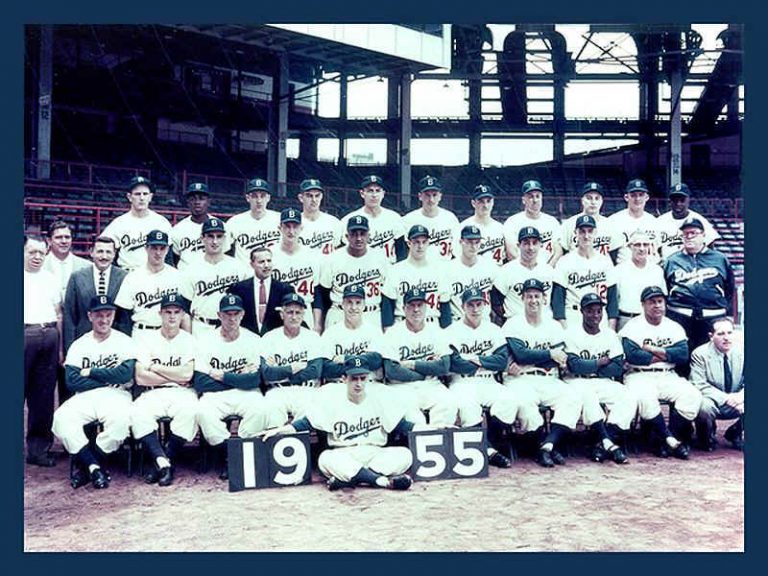
The 1955 Brooklyn Dodgers. The book "The Boys of Summer" by Roger Kahn details the Dodgers teams of the 1950s. Photo: nsnn.com

The gift-giving season is fast approaching; so in the spirit of “news you can use,” I have put together a Top Dozen list of great sporting reads.

To be clear, these are not, on the whole, new books, but since the internet became ubiquitous, you can track down just about any title with relative ease.

Some of them are not even wholly about sport.

What they have in common, besides some sort of sporting reference, is that I have found them absorbing and/or hugely enjoyable.

Any one of them is well worth curling up with during these long northern-hemisphere winter nights.

In no particular order:

1. The Soccer War by Ryszard Kapuściński (1990)

The Polish journalist, who died in 2007, is mainly known for his writing about Africa. And indeed that continent features heavily in this collection of pieces about his experiences as foreign correspondent for the Polish Press Agency.

The story that gives the collection its title, however, concerns a 100-hour war between Honduras and El Salvador sparked by the two Central American neighbors’ efforts to qualify for the 1970 World Cup. As an illustration of how, while sport itself might be trivial, its consequences can be of the utmost seriousness, you cannot beat it.

Typical sentence: “Luis Suarez said there was going to be a war, and I believed whatever Luis said.”

2. The Boys of Summer by Roger Kahn (1972)

Classic, extended account of the 1950s Brooklyn Dodgers baseball team, so often pipped at the post by the New York Yankees, and what became of them.

Kahn interweaves reminiscences of his job reporting on the team with scenes from his home life to build an indelible picture of early post-war America which is tinged with both nostalgia and melancholy.

Typical sentence: “The team was broken up and with my father dead there was no one with whom I wanted to consider that tragedy, and because there was no-one I recognized that the breaking of a team was not like greater tragedy: incompleteness, unspoken words, unmade music, withheld love, the failure ever to sum up or say good-bye.”

3. A Supposedly Fun Thing I’ll Never Do Again by David Foster Wallace (1997)

This collection of essays by one of the most intense and brilliant US writers of recent decades is on the list because of two relatively short pieces concerning tennis that I think taught me more about that tough, lonely and draining sport than anything I recall reading before or since.

In his early teens, Foster Wallace was, in his own words, a “near-great junior tennis player”. That meant he had thought about the game, and strategies for winning matches, a great deal. I doubt that any better, more penetrative writer has ever subjected the sport to this degree of analysis.

The collection’s title, I should point out, does not refer to tennis.

Typical sentence: “In late childhood I learned how to play tennis on the blacktop courts of a small public park carved from farmland that had been nitrogenized too often to farm anymore.”

4. Behind the Curtain – travels in eastern European football by Jonathan Wilson (2006)

A former colleague and present team-mate, Wilson has become prolific in his (early) middle age. This wryly sympathetic look at a much-abused region and its rich and inventive football culture remains my favorite among his books.

His account of his misadventures while attempting to file his report on an Azerbaijan versus England World Cup qualifier is a comic masterpiece. His footballing history of Argentina, Angels With Dirty Faces, came out in August.

Typical sentence: “I’m not saying that if I hadn’t gone to Bohinj in 1984 I’d now be writing a history of football in the Lake District, but there’s no question that those holidays made me far more aware of Communism, and particularly of Yugoslavia.”

5. The Meaning of Cricket by Jon Hotten (2016)

This is a new book, in which Hotten, another team-mate, distills half a lifetime of cricket wisdom into 220 hard-won, sometimes elegiac pages.

Beginning with a chapter explaining how, if you can lay cricket bat on ball even once, you are performing a minor miracle, is a clever move apt to endear him to his audience – well half of them at least. But what really struck me was how many of Hotten’s cricketing preoccupations and insecurities were also mine. A little gem.

Typical sentence: “My first memory of cricket is probably unreliable, an amalgam of sensory flashbacks from different moments, but I’m in the kitchen at home with my first proper bat, a Stuart Surridge that cost four quid from the sports shop in Fleet and that I could barely lift. The song playing on the radio is ‘Rhinestone Cowboy…”

6. The Meaning of Sport by Simon Barnes (2006)

Reflections, set down in 158 short, staccato passages, covering Barnes’s various assignments as a sportswriter between 2004 and 2006.

Though he ends with an acknowledgement of failure, I doubt any other contemporary sports journalist could have carried this format off so successfully. It is Barnes’s sheer intelligence and effortlessly broad frame of reference that make the difference. The effect is of embarking on a mesmerizing mystery tour on which you never quite know where you are heading next, but are confident that every fresh turn will be somehow illuminating.

Typical sentence: “To tell the truth, I was never much good at telling one Australian batsman from another – it was just a succession of grim, unshaven jaws, chewing gum as if it were the flesh of an enemy, glowering behind the grills of grim green helmets and belting the ball vindictively, knowing that, if they failed, two more would spring up to take their place.”

7. The Blind Side – evolution of a game by Michael Lewis (2006)

My main reason for including this American football book by Moneyball author Lewis is the purple passage describing a four-and-a-bit second slab of action with which it begins.

The New York Giants’ Lawrence Taylor is about to hit Joe Theismann of the Washington Redskins. If there is a more riveting dissection and contextualisation of such a short passage of sporting action, I have yet to come across it.

Typical sentence: “From the snap of the ball to the snap of the first bone is closer to four seconds than to five.”

8. Put Me Back On My Bike – in search of Tom Simpson by William Fotheringham (2002)

A studious, pitch-perfect biography of the charismatic English cyclist who perished on Mont Ventoux in 1967.

Larded with fascinating, precise detail, such as the Nottinghamshire-raised Simpson’s obsession with diet, the book does not accept easy answers. The extended passage trying to pin down just why Simpson died is a model of open-minded, evidence-based journalistic inquiry.

Typical sentence: “Simpson should be remembered as an impulsive, intelligent, articulate and supremely charismatic man who had a single blind spot: his need to win at any cost.”

9. The Sportswriter by Richard Ford (1986)

I was unsure whether to include this or its sequel, Independence Day, which is a better, indeed a towering, book, but in which Ford’s main character, Frank Bascombe, has moved into real estate. Both are well worth your time.

Bascombe is a sort of everyman, negotiating the trials and tragedies of existence in late 20th-century USA with whatever poise and optimism he can muster. With its sometimes meandering sentences which mask a rapier-sharp mind, the book is not especially flattering about the craft of sportswriting.

Typical sentence: “A group of sportswriters together can narrow your view far beyond pessimism, since the worst of them tend to be cynics looking only for false drama in the germs of human defeat.”

10. Bookie, Gambler, Fixer, Spy – a journey to the heart of cricket’s underworld by Ed Hawkins (2012)

An authority on sports betting travels to India to discover just what it is – and, equally importantly, is not – possible to stake money on.

A model piece of extended investigative reporting by a writer with the contacts and know-how to shine a little light into a covert field. It took courage, unwavering focus and a limpid prose style to pull off.

Typical sentence: “There can be no doubt that an experienced fixer would know that it is not possible to bet on a no-ball.”

Finally, two wonderful older works that might take a little bit more effort to find.

11. The Great Fight of the French Fifteen by Denis Lalanne (1959)

A wonderfully vivid, colorfully-written account of the 1958 French rugby union tour to South Africa. The book underlines just how tough a sport this is and was, even before professionalism made players bigger, fitter and faster.

Lalanne offers the occasional glimpse into the conditions and attitudes spawned by the vile apartheid regime, such as when a French drop goal is greeted in a non-white section of the crowd by an uproar “as indescribable as the one they had made which drowned the South African national anthem before the kickoff.”

The dust-jacket of my copy of the book, translated by E.J.Boyd-Wilson, says it was the first French book to have its first English-language publication in New Zealand. One wonders if there was ever another.

Typical sentence: “There are two kinds of players: those who play pianos and those who shift them.”

12. My Life – and Arkle’s by Pat Taaffe (1972)

I generally approach sporting autobiographies with more of a sense of duty than of anticipation. Yet this slim volume by the great steeplechaser Arkle’s regular jockey was an unexpected pleasure to read.

Just 80 pages long, it is as if each word had to be wrung out of the old horseman like water from a flannel. But what he does say rings true and distinctive like a fine single malt.

I had come to the book while doing research for Foinavon, whom Taaffe also rode more often than most. His verdict? “If he had been a man, he’d have spent his days, hands in pockets, whistling through his teeth, scuffling the dust.”

By David Owen

Republished with permission from insidethegames.biz

Figure Skating Events at Pyeongchang 2018 to be in Morning to Suit American Televison

0
Figure Skating Events at Pyeongchang 2018 to be in Morning to Suit American Televison
Tessa Virtue and Scott Moir of Canada perform during an ice dance figure skating training session at Iceberg Skating Palace during the Sochi 2014 Olympic Games, Sochi, Russia, Photo: EPA/HOW HWEE YOUNG

Figure skating finals at the 2018 Winter Olympic Games in Pyeongchang are set to be held in the morning session to suit television audiences in the United States, it has been revealed.

A statement from the Pyeongchang 2018 confirmed the Kyodo News reports that figure skating, a sport which is usually staged in the evening, would start early during the Games in the South Korean resort.

Pyeongchang, located around 130 kilometers from Seoul, is currently 14 hours ahead of New York, which would mean competitions held in the morning would fit in with evening television schedules in the US.

It comes due to the large influence of American broadcaster NBC, which paid sum of $7.65 billion to the International Olympic Committee (IOC) for exclusive rights to broadcast all Summer and Winter Olympics until 2032.

According to the draft schedule of events at the 2018 Winter Olympics, the first-ever edition of the event to take place in South Korea, figure skating would start at 10 a.m. local time and conclude at 2 p.m.

The Gangneung Ice Arena is due to play host to figure skating at Pyeongchang 2018.

The men’s short program gets the sport underway at the Games on February 16, with the free skate scheduled for the following day.

The women’s short program then comes to the fore on February 21, two days before the free skate.

“The IOC and International Sports Federations are currently in talks about the competition schedules,” Pyeongchang 2018 said.

“At present figure skating is assigned to the morning session, and if it is deemed alright, the current schedule is likely to go ahead.”

Snowboarding is also reportedly likely to take place earlier in the day to appease the American viewers.

It is not the first time sports have been moved to accommodate television audiences as the swimming finals at the Beijing 2008 were brought forward to the morning so American fans could see star performer Michael Phelps go for gold.

By Liam Morgan

Republished with permission from insidethegames.biz